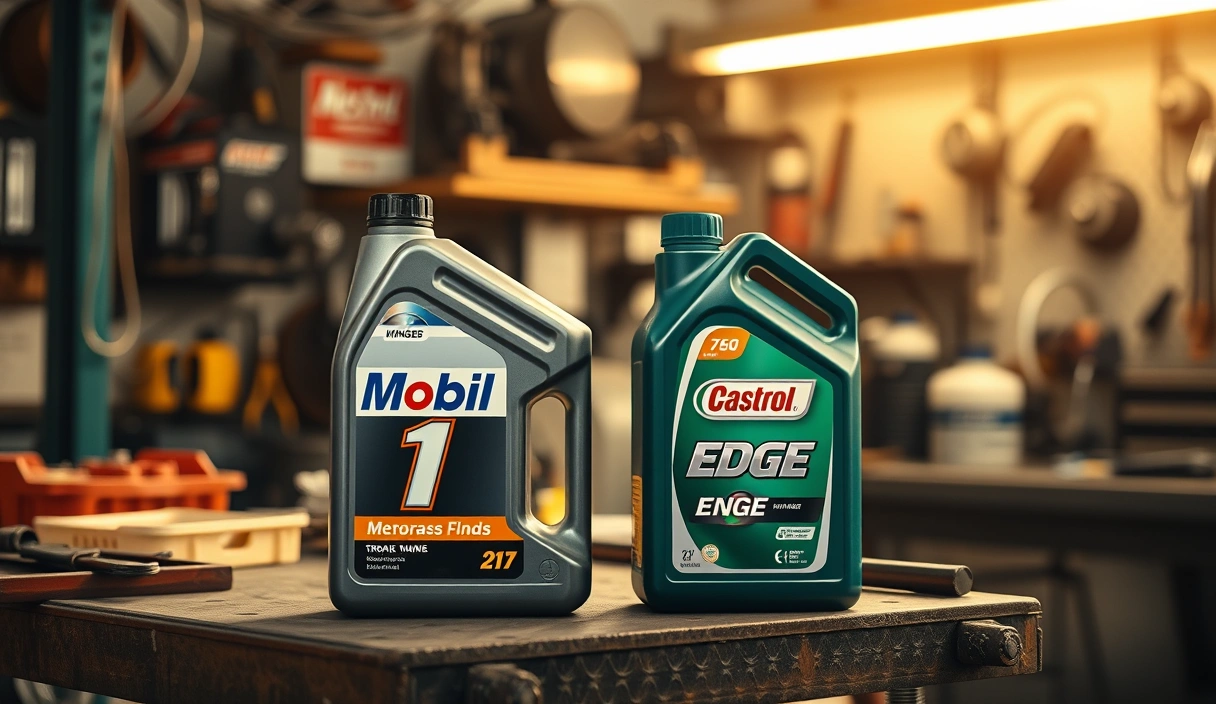
Mobil 1 vs. Castrol Edge: Which Brand Actually Wins?
Mobil 1 vs. Castrol Edge: same base stock, same price. The real difference is OEM certifications — dexos1 for GM, BMW Longlife for Castrol.
Contents
The Mobil 1 vs. Castrol Edge argument has been running on car forums since at least 2005. Someone posts a question, and forty replies later the thread has covered base oil chemistry, NASCAR sponsorship deals, and one guy’s 2001 Civic that “runs forever on Castrol.” The tribalism is real. It is almost entirely divorced from the actual data.
Here’s what used-oil analysis from the BITOG community and OEM certification sheets actually say.
What You’re Actually Comparing When You Choose Between These Two Oils
Both are full synthetic Group III base stock — severely hydrocracked petroleum refined until the molecular structure is uniform enough to meet the legal definition of synthetic. That is not the same as Group IV (polyalphaolefin, chemically built from scratch). Neither standard retail Mobil 1 5W-30 nor Castrol Edge 5W-30 uses PAO base stock, whatever the marketing implies.
Both carry API SP certification — the current highest standard for gasoline engines, requiring LSPI (Low Speed Pre-Ignition) protection and GDI engine compatibility. Both cost roughly $27–32 for a 5-quart jug in the US market.
The real differentiator is not base oil quality (comparable) or price (the same). It’s additive package design and, more practically, OEM-specific certification. If you’re not yet sure either brand is your answer, the best synthetic motor oil roundup covers six brands across more use cases and price points.
Additive Technology: What the Chemistry Actually Does
Castrol Edge — Fluid TITANIUM
Castrol markets its additive package under the “Fluid TITANIUM” name. The mechanism: titanium dioxide particles suspended in the oil matrix are designed to reduce metal-to-metal friction under high-load, high-shear conditions — specifically the bearing stress a turbocharger creates at 100,000+ RPM.
Castrol’s own tribology testing claims a film 10x stronger than conventional oil under pressure. That comparison is against conventional oil, not Mobil 1. Independent used-oil analysis data from BITOG — which aggregates thousands of sample reports from actual engines at actual drain intervals — shows no statistically significant wear reduction for Castrol Edge over Mobil 1 at normal 5,000–7,500 mile drains. Iron, copper, and aluminum wear metals trend comparably between the two brands in fleet data for similar applications.
The Fluid TITANIUM advantage, if it exists in a measurable way, shows up under sustained extreme load. At normal driving and normal drain intervals, the practical difference is negligible.
Mobil 1 — SuperSyn Anti-Wear Technology
Mobil 1’s additive system, called SuperSyn, is a phosphorus/zinc (ZDDP) and organic molybdate blend. The claimed benefit: a protective film that holds up to 500°F oil temperatures and retains its properties over extended drain intervals. Mobil 1 Extended Performance formulations are specifically engineered for 15,000-mile intervals under the right conditions — a spec Castrol Edge doesn’t match in its standard retail offering.
The same caveat applies here. BITOG used-oil analysis threads comparing Mobil 1 and Castrol Edge in comparable engines show similar wear numbers at 5,000–7,500 miles. The chemistry difference is not visible in used-oil data under typical conditions. Both formulas work. The argument about which is “better” at a molecular level is a marketing construct when either oil is changed on schedule.
OEM Certifications: Where the Mobil 1 vs. Castrol Edge Decision Gets Made
Certification is the practical dividing line. If your owner’s manual lists a specific OEM approval code, that code overrides brand preference. Here’s how the two split on the most common approvals.
Castrol Edge for European OEM Specifications
Castrol Edge Professional is BMW’s factory-fill oil. For BMW owners whose manuals specify BMW Longlife-04 or BMW Longlife-17 FE+, Castrol Edge Professional is the direct match. The European OEM approval list is Castrol’s strongest competitive advantage over Mobil 1:
- Audi/Volkswagen 502.00, 504.00, 507.00 (Long Life specification): Castrol Edge Professional A3/B4 and C3 variants carry these approvals. Mobil 1 covers some Audi/VW specifications but not the full Longlife suite.
- Mercedes-Benz MB 229.5 and 229.51: Castrol Edge Professional holds these in the relevant grades.
- Porsche A40: Castrol Edge Professional carries this approval for Porsche engines specifying the A40 standard.
Mobil 1 has European approvals on some formulations, but if your car is a BMW, Audi, VW, or Mercedes that lists a specific approval code in the maintenance section rather than just a viscosity grade, Castrol’s approval lookup is the better first stop. The probability of a direct match is higher.
Practical example: a 2022 BMW 330i running BMW Longlife-04 spec needs Castrol Edge Professional LL or the equivalent approval. A generic “full synthetic 5W-30” — including standard Mobil 1 5W-30 — does not meet the Longlife-04 requirement. The certification matters, the brand name alone doesn’t.
Mobil 1 for GM dexos1 Gen 3 Requirements
dexos1 Gen 3 is GM’s mandatory specification for all vehicles manufactured from model year 2021 onward — Chevrolet, GMC, Cadillac, and Buick. Mobil 1 is a licensed dexos1 Gen 3 oil. Castrol Edge does not carry dexos1 Gen 3 approval in its standard US retail formulations.
A 2023 Chevrolet Colorado with the 2.7T four-cylinder requires dexos1 Gen 3. Castrol Edge at retail doesn’t qualify. Mobil 1 does. Using a non-dexos oil in a dexos-required GM engine can void the powertrain warranty per GM’s published policy — that’s a hard line, not a preference.
For Ford and Stellantis vehicles (Ram, Jeep, Dodge, Chrysler), neither brand has a dominant approval advantage. Both meet API SP, which covers the specifications for most domestic vehicles outside the GM dexos ecosystem.
Side-by-Side: Mobil 1 vs. Castrol Edge
| Category | Mobil 1 | Castrol Edge |
|---|---|---|
| Base Stock | Group III | Group III |
| API Certification | SP | SP |
| Additive Tech | SuperSyn (ZDDP + molybdate) | Fluid TITANIUM (titanium complex) |
| GM dexos1 Gen 3 | Yes | No |
| BMW Longlife-04/17 | Limited | Yes (Professional) |
| Audi/VW Longlife specs | Limited | Yes (Professional) |
| Mercedes MB 229.x | Limited | Yes (Professional) |
| Extended Drain Formulation | Yes (Extended Performance, 15k mi) | Limited |
| Price (5qt, US market) | ~$27–32 | ~$27–32 |
| BITOG Wear Data (normal drain) | Comparable | Comparable |
| Best Application | GM vehicles, dexos1 spec | European OEM vehicles, BMW/VW/MB |
Compare Mobil 1 and Castrol Edge


* Affiliate links. Prices last updated March 6, 2026.
Which One Should You Actually Buy?
Three practical rules that handle most situations:
Buy Mobil 1 if your vehicle is a GM product — Chevrolet, GMC, Cadillac, or Buick — manufactured from 2021 onward, or if your owner’s manual explicitly specifies dexos1 Gen 3. This is not a preference. It is a warranty coverage requirement, and Castrol Edge at retail does not meet it. The dexos1 Gen 3 spec also covers LSPI protection requirements specific to GM’s turbocharged four-cylinder lineup, so the certification matters beyond just the warranty language.
Buy Castrol Edge if you drive a BMW, Audi, VW, Mercedes, or Porsche that lists a specific European OEM approval code in the maintenance section. The BMW Longlife and Audi/VW Long Life portfolio is Castrol’s clearest advantage, and no other US-retail synthetic matches its European approval breadth. If your manual says “BMW Longlife-04” or “VW 507.00,” those codes narrow your field to certified formulations only — and Castrol Edge Professional is usually on the short list.
Buy either one if your car is a Japanese or Korean brand — Toyota, Honda, Mazda, Subaru, Hyundai, Kia — that specifies API SP and a viscosity grade with no additional approval code. Neither brand has a measurable advantage for these applications at normal drain intervals. Buy whichever is on sale, or whichever your auto parts store stocks reliably. At 5,000–7,500 mile changes, the used-oil analysis data is indistinguishable between the two.
The forum debate will continue. Your owner’s manual already settled the question — it’s written in the OEM approval codes, not in brand logos.
For another comparison in this tier, the Pennzoil vs. Mobil 1 article covers how Pennzoil Ultra Platinum stacks up against Mobil 1 on base oil chemistry and certification.
Related Articles
Frequently Asked Questions
Is Mobil 1 better than Castrol Edge?
Neither is objectively better. Both use Group III base stock and carry API SP certification. Performance in used-oil analysis at normal drain intervals is comparable between the two. The right choice is determined by your vehicle’s OEM approval requirements: Mobil 1 for GM dexos1 vehicles, Castrol Edge for European OEM specs like BMW Longlife or Audi/VW Long Life.
Can I switch from Mobil 1 to Castrol Edge?
Yes, at any scheduled oil change. Both are full synthetic API SP oils with compatible additive chemistry. No flushing is required between brands. As long as you maintain the correct viscosity grade and any required OEM approval codes for your vehicle, the switch is chemically safe.
Does Castrol Edge’s Fluid TITANIUM technology make a real difference?
At normal 5,000–7,500 mile drain intervals, BITOG used-oil analysis data shows no statistically significant wear reduction compared to Mobil 1 SuperSyn. The Fluid TITANIUM benefit is most plausible under sustained high-load conditions — turbocharger bearing stress at high RPM — but under typical driving and drain intervals, the measurable difference in wear metals is negligible.
Which oil is better for turbocharged engines?
Both meet API SP requirements for turbocharged GDI engines. Castrol Edge is the more common choice for high-output European turbos because the OEM approval overlap with BMW, Audi, and VW is stronger. For turbocharged GM engines, Mobil 1’s dexos1 Gen 3 certification is the correct choice.
Does it matter which brand I use if my manual just says “full synthetic 5W-30”?
No — not from a performance standpoint. If your manual specifies only a viscosity grade and API SP (or SN), both Mobil 1 and Castrol Edge are interchangeable. The brand question only becomes relevant when a specific OEM approval code appears in the maintenance section. If no approval code is listed, buy the one that’s on sale.
Related Articles
AMSOIL vs. Mobil 1: Is the Premium Price Worth It?
AMSOIL Signature Series costs roughly twice what Mobil 1 does. Here's what you actually get for the premium, and whether it changes for your engine.
Best Synthetic Motor Oils 2026 (Tested and Ranked)
The best synthetic motor oil for most drivers is Mobil 1 Advanced Full Synthetic. Here's how 6 top brands compare — plus which to buy for your engine.

Best Oil for Turbocharged Engines: What Actually Protects a Turbo
The best oil for turbocharged engines is full synthetic API SP — brand and viscosity matter too. Here's what turbos need and which oils deliver it.