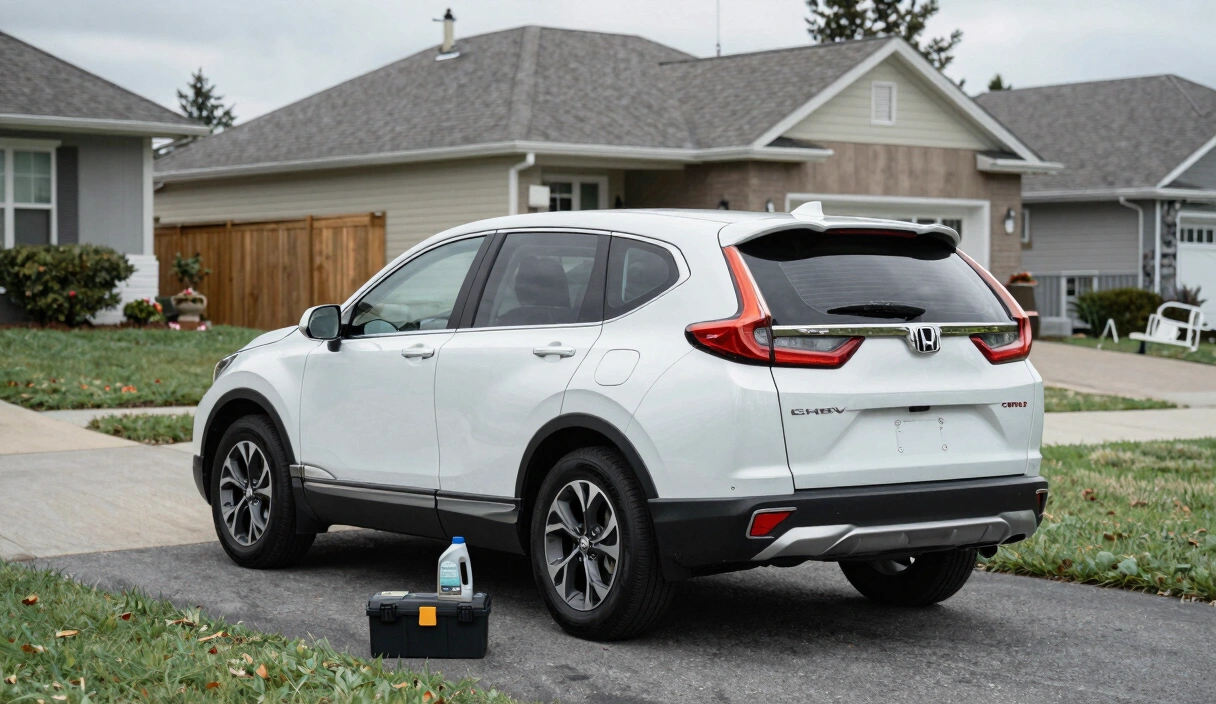
Mobil 1 vs Castrol Edge for Honda CR-V: Which Holds Up Better?
Both meet the Honda 0W-20 spec. The real question is how each handles the 1.5T fuel dilution issue and the hybrid's heat profile. Here's the data.
Contents
Honda settled a class-action lawsuit in 2020 over fuel dilution on 2017–2020 CR-V 1.5L turbocharged engines. The complaint: in cold-weather, short-trip operation, unburned fuel was diluting the crankcase oil to the point where the dipstick ran high, the oil viscosity dropped meaningfully, and the engine started showing symptoms (rough cold-start, oil burn-off, in some cases bearing wear) at well below typical service intervals. The settlement covered an extended warranty and software updates. It did not cover the underlying physics, and the issue still exists in milder form on 2021+ CR-V 1.5T engines and to a lesser degree on the hybrid.
Which is to say: when you’re picking between Mobil 1 and Castrol Edge for a Honda CR-V, you’re not really picking on additive chemistry. You’re picking on which oil holds viscosity better when fuel is being diluted into it during cold operation. That’s a different question, and it changes the answer.
What Honda Actually Specs (and Why It Matters)
Every CR-V from model year 2017 forward calls for SAE 0W-20 full synthetic. That’s true for the 1.5T turbocharged gas model, the 2.0L hybrid (CR-V Hybrid 2018+), and the 2023+ redesigned hybrid that uses the e:HEV system. The viscosity grade is non-negotiable — 5W-30 in a CR-V 1.5T causes meaningful fuel economy loss and may trigger oil pressure warnings on cold starts.
Both Mobil 1 Advanced Full Synthetic 0W-20 and Castrol EDGE 0W-20 meet:
- API SP (current US standard, includes LSPI protection that turbocharged engines need)
- ILSAC GF-6A (current US fuel-economy spec)
- Honda HTO-06 compatibility (Honda’s older turbo spec, applicable to some 1.5T variants)
Below the spec sheet, the formulations diverge in ways that matter specifically for the CR-V’s failure mode.
The Fuel Dilution Question: Where the Real Difference Is
Here’s the mechanism: the 1.5T direct-injection engine, in cold or short-trip operation, doesn’t fully combust every fuel injection event. Some of that unburned fuel gets past the rings into the crankcase, where it accumulates faster than the engine reaches operating temperature long enough to boil it back out. The result: oil that started as 0W-20 is, by 2,000 miles in a Minneapolis winter, behaving more like 0W-15 or thinner.
The oil that handles this best is the one with the most stable HTHS viscosity under fuel contamination. That’s a real, measurable property that diverges between brands even when they’re the same nominal grade.
Mobil 1 Advanced Full Synthetic 0W-20: Uses ExxonMobil’s SuperSyn additive package, with a phosphorus/zinc anti-wear chemistry and viscosity-index improvers tuned for shear stability. Used-oil analysis from BITOG threads on CR-V 1.5T engines tends to show Mobil 1 holding viscosity slightly better under fuel dilution than the Castrol Edge formulation — typically a 0.2–0.4 cSt smaller drop over a comparable service interval.
Castrol EDGE 0W-20: Uses the Fluid TITANIUM additive system. Castrol’s marketing emphasizes friction reduction at metal-to-metal contact under high-load conditions — the bearing stress a turbocharger generates at high RPM. That’s a real benefit for a high-RPM driving profile. For a CR-V doing mostly suburban commutes, it’s less directly relevant. The fuel dilution numbers in CR-V UOAs trend slightly worse than Mobil 1, though both stay in spec at normal Honda Maintenance Minder intervals.
For the broader Mobil 1 vs Castrol Edge comparison across applications beyond Honda, the direct brand comparison covers OEM approvals and additive technology in more detail. For the CR-V specifically, the fuel dilution lens is the one to use.
What That Means in Practice
If you drive your CR-V mostly highway miles and longer trips (15+ minutes per drive), fuel dilution is not your problem. Either oil works. Pick on price.
If you live in a cold climate (think anywhere with sustained sub-30°F winters) and your driving pattern is short trips — school runs, grocery store, work commute under 10 miles — Mobil 1 Advanced Full Synthetic 0W-20 has the slight edge in shear stability under fuel contamination. The advantage isn’t dramatic. It’s the difference between an oil that holds spec for 7,500 miles vs one that’s marginal at 6,000.
If you’re towing or driving in mountains (CR-V owners do tow small trailers), the Castrol Fluid TITANIUM advantage under sustained load becomes more relevant. For occasional highway towing on trips of 30+ minutes, Castrol Edge has a defensible case.
For most CR-V owners doing typical suburban duty? The choice is essentially a coin flip on protection. Mobil 1 typically wins on price-per-quart at chain retailers; Castrol Edge typically wins on per-quart price during sale events. Buy whichever is cheaper at the moment of need.

The Hybrid Variant Has Its Own Profile
The CR-V Hybrid (2018+, redesigned 2023+) runs the 2.0L Atkinson-cycle gas engine cycling on and off as the e:HEV system manages traction. That driving profile is fundamentally different from the 1.5T’s continuous combustion duty:
- More cold starts per mile. The engine cycles on and off frequently, so the oil sees more cold-start events than the same mileage would produce in a non-hybrid.
- Less sustained high-RPM operation. The 2.0L Atkinson runs at narrow load bands optimized for thermal efficiency, so HTHS shear under sustained load is rarely a factor.
- Lower fuel dilution risk. The 2.0L hybrid engine is port-injected (not direct-injected like the 1.5T), and it runs leaner overall — fuel dilution is significantly less of an issue.
For the hybrid, the cold-start protection of a true 0W-20 is the priority, and both Mobil 1 and Castrol Edge handle it well. The pour points and cold-cranking viscosities are essentially identical for both brands at the 0W-20 grade. Without the fuel dilution failure mode pushing the choice, the hybrid is the one CR-V variant where the brand decision really is largely a wash.
For 100,000-mile and beyond hybrids, a switch to a high-mileage 0W-20 (Valvoline MaxLife or Mobil 1 High Mileage) starts to make sense for the seal conditioners — but that’s a choice driven by mileage, not by hybrid vs gas.
What About Honda Genuine 0W-20?
Honda dealerships sell Honda-branded 0W-20 full synthetic at premium pricing. The oil is produced by Idemitsu (Japan) under Honda’s spec. It carries the Honda logo and meets HTO-06 specifically rather than just being broadly compatible with it.
Functionally, Honda Genuine 0W-20 is comparable to Mobil 1 and Castrol Edge in protection level. The dealer markup is typically 30–50% over the equivalent name-brand synthetic — meaning a $26 jug becomes a $38 jug. The argument for buying Honda Genuine: warranty coverage on a brand-new CR-V where the dealer service department wants to see Honda fluids in the records. The argument against: the protection is the same, and aftermarket brands meet the spec.
For warranty purposes on a 2024+ CR-V still under Honda’s New Vehicle Limited Warranty, using a name-brand 0W-20 that meets API SP and ILSAC GF-6A is fully compliant with Magnuson-Moss Warranty Act requirements. Honda cannot void your warranty for using Mobil 1 or Castrol Edge instead of Honda Genuine — the consumer protection law specifically prevents tying warranty coverage to OEM fluid purchase.
Recommended Picks
The 0W-20 picks below are the three most-stocked full synthetics across major US retailers, each meeting the CR-V’s spec requirements.
Three 0W-20 Full Synthetics for Honda CR-V

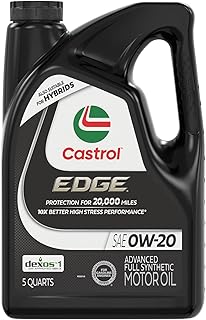

* Affiliate links. Prices last updated July 17, 2026.
For high-mileage CR-Vs starting to use oil between changes (typical at 100K+ on the 1.5T), the best oil for turbocharged engines covers the high-mileage and turbo-specific options in more depth.
Service Interval — What Honda Actually Says
Honda’s Maintenance Minder system is the authority. The algorithm calculates oil life based on:
- Engine RPM and load
- Coolant temperature curves (cold-start cycle counts)
- Cumulative engine hours
- Driving pattern (highway vs stop-and-go)
The 15% Oil Life threshold is Honda’s call to schedule the change. The 5% threshold is the urgent warning. For a 1.5T CR-V doing typical suburban driving, the system usually triggers between 5,000 and 7,500 miles. For a CR-V Hybrid, intervals tend to run longer — 7,500 to 10,000 miles is common.
Both Mobil 1 Advanced Full Synthetic and Castrol Edge can comfortably hold protection across that interval. What you want to avoid: ignoring the Maintenance Minder beyond the 5% warning, particularly on a 1.5T in winter operation. That’s where fuel dilution moves from “measurable but harmless” to “potentially damaging.”
Bottom Line
For most Honda CR-V owners — suburban driving, mixed highway and city, typical seasons — Mobil 1 Advanced Full Synthetic 0W-20 and Castrol Edge 0W-20 are functionally interchangeable. Buy whichever is on sale.
The narrow case where Mobil 1 has a real edge: 1.5T CR-V driven mostly short trips in cold weather. The slight shear stability advantage matters when fuel dilution is in play.
The narrow case where Castrol Edge has a real edge: 1.5T CR-V used for occasional towing or sustained high-load highway driving. The Fluid TITANIUM friction reduction has measurable benefit under sustained turbocharger bearing stress.
Hybrid CR-V owners can stop reading and pick on price. The hybrid powertrain doesn’t push either oil into its failure mode.
Frequently Asked Questions
Is Mobil 1 or Castrol Edge better for a Honda CR-V 1.5T?
For typical mixed driving, both are essentially equivalent. The narrow advantage goes to Mobil 1 for cold-climate, short-trip driving where fuel dilution is the dominant failure mode — the SuperSyn additive package shows slightly better shear stability under fuel contamination in CR-V used-oil analysis data. For highway-heavy or towing use, Castrol Edge’s Fluid TITANIUM friction reduction has a defensible advantage under sustained turbocharger bearing load.
Can I use 5W-30 in my Honda CR-V?
No, not without violating Honda’s spec and triggering measurable consequences. The CR-V 2017+ is engineered specifically around 0W-20 viscosity — bearing clearances, oil pump capacity, and the variable valve timing system are all tuned to it. Using 5W-30 will reduce fuel economy by 1–3%, may trigger oil pressure warnings on cold starts, and can compromise the timing chain tensioner system on the 1.5T. Stick with 0W-20.
Does the Honda CR-V Hybrid use the same oil as the 1.5T?
Yes — both use SAE 0W-20 full synthetic meeting API SP. The hybrid’s 2.0L Atkinson engine has a different injection system (port-injection rather than direct-injection) and a less aggressive duty cycle, but the oil specification is identical. The hybrid does not need a “hybrid-specific” oil despite some marketing that suggests otherwise.
How often should I change oil in a Honda CR-V?
Follow the Maintenance Minder, not a fixed mileage. Honda’s algorithm typically triggers between 5,000 and 7,500 miles for the 1.5T under mixed driving, and 7,500 to 10,000 miles for the hybrid. Change at the 15% Oil Life indicator; don’t push past the 5% warning, especially on the 1.5T in winter.
Does using non-Honda oil void my CR-V warranty?
No. The Magnuson-Moss Warranty Act prevents Honda from requiring Honda Genuine fluids as a condition of warranty coverage, as long as the oil you use meets the specification (SAE 0W-20, API SP, ILSAC GF-6A). Both Mobil 1 Advanced Full Synthetic 0W-20 and Castrol Edge 0W-20 meet those requirements and are warranty-compliant.
What about the Honda CR-V fuel dilution recall?
The 2017–2020 CR-V 1.5T engines were subject to a class-action settlement covering an extended warranty (one extra year on the powertrain) and ECU software updates that adjusted cold-start fueling. The underlying tendency of direct-injected turbo engines to dilute oil in cold short-trip operation persists in milder form on later model years. Choosing an oil with strong shear stability (Mobil 1 has a slight edge here) and following the Maintenance Minder rather than extending intervals are the practical mitigations.
Related Articles
Mobil 1 vs. Castrol Edge: Which Brand Actually Wins?
Mobil 1 vs. Castrol Edge: same base stock, same price. The real difference is OEM certifications — dexos1 for GM, BMW Longlife for Castrol.

Pennzoil Platinum vs. Mobil 1: The Honest Comparison
Pennzoil vs. Mobil 1: both are full synthetic API SP oils at similar prices. The real differences come down to base oil source and certification coverage.
AMSOIL vs. Mobil 1: Is the Premium Price Worth It?
AMSOIL Signature Series costs roughly twice what Mobil 1 does. Here's what you actually get for the premium, and whether it changes for your engine.