Engine Oil Sludge: Causes, Symptoms, and How to Fix It
Engine oil sludge can kill your engine silently. Learn what causes it, how to spot it, and the exact steps to flush and prevent it for good.
Contents
I’ve pulled a lot of valve covers. Most of the time you see what you expect — some varnish, maybe a little residue where the PCV does its worst work, the general patina of an engine that’s been doing its job for years. But there’s one afternoon I still think about. A friend’s 2003 Toyota Camry, 130-something thousand miles, and I’m expecting a routine top-end inspection.
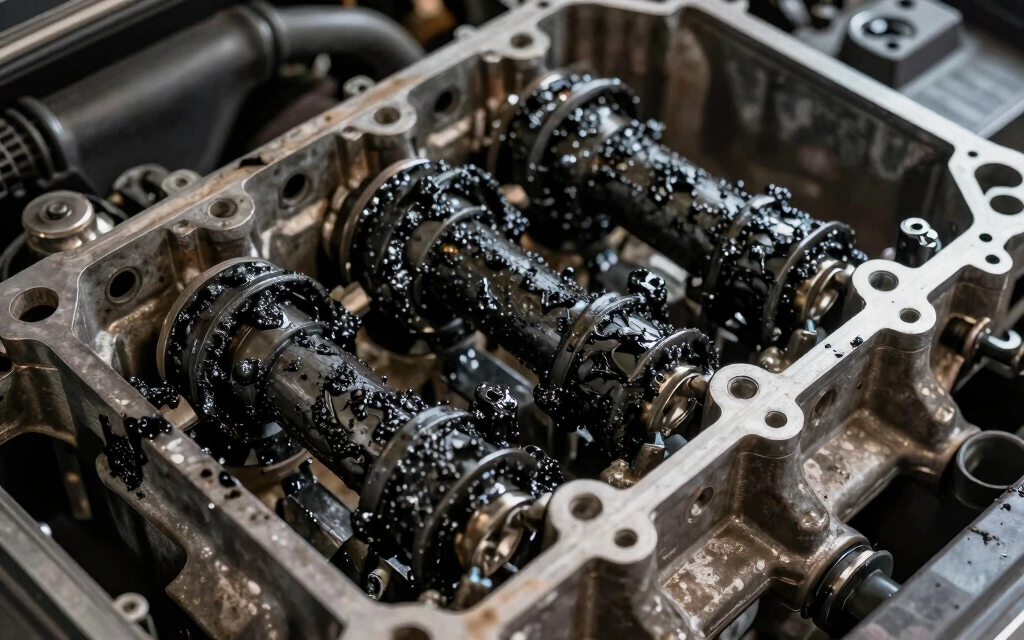
What I found instead was a tar pit. Thick black paste coating every cam tower. The kind of material that doesn’t drip — it holds its shape when you scrape it with a flathead. I knew immediately what had happened. Not the engine. The owner.
That engine had been running on extended intervals with conventional oil through a Minnesota winter. The oil had done what oil does when it’s pushed past its limits: it oxidized, thickened, and eventually stopped being oil in any meaningful sense. What was left was engine sludge — and it had already done some work before I got there.
Here’s what actually happened inside that engine, why it happens, and what to do if you’re looking at something similar.
What Is Engine Oil Sludge?
Sludge is what motor oil becomes when it fails. Not just dirty — failed. Oxidized, contaminated, and chemically transformed from a liquid lubricant into a gel-like or semi-solid deposit that doesn’t flow, doesn’t lubricate, and doesn’t belong anywhere near a running engine.
Sludge vs. Dirty Oil: What’s the Actual Difference
Normal used oil gets dark. That’s expected — soot from combustion and oxidation byproducts darken oil even in a well-maintained engine. Dark oil on the dipstick isn’t sludge.
Sludge is different in consistency and location. Where dirty oil flows freely off the dipstick, sludge is thick, sticky, and resistant. On the valve cover, it looks like black mayonnaise or thick paste. In oil passages, it restricts flow or blocks them completely. The chemical difference: dirty oil has degraded additives but still has its base stock structure. Sludge has undergone oxidation and polymerization to the point where the molecular structure has been permanently altered.
Where Sludge Forms First Inside Your Engine
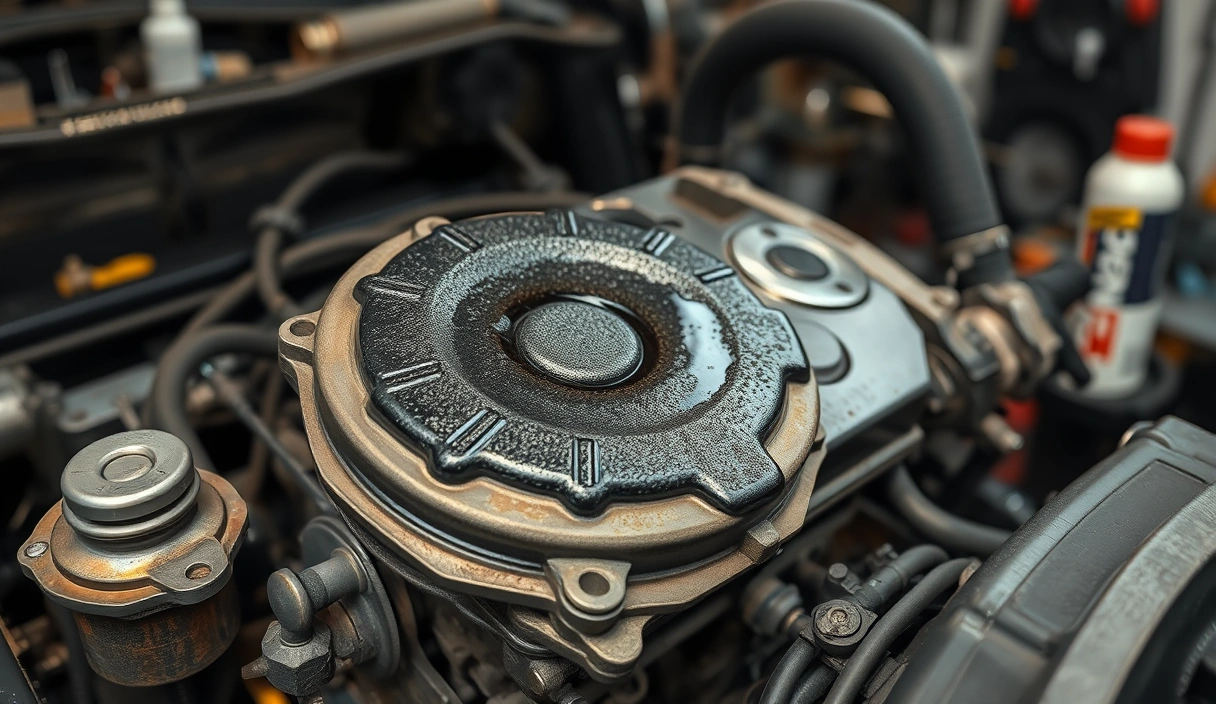
Sludge doesn’t appear everywhere at once. It starts in areas of highest heat and lowest oil circulation velocity — the top of the engine near the valve train, PCV system passages, and oil galleries with slow flow rates. The valve cover is usually the tell-tale inspection point. If you pop the oil filler cap and see black buildup visible on the underside, sludge is already present somewhere in the top end.
From there, it works its way down toward the oil pan and into the narrow passages feeding the crankshaft and rod bearings. That’s when the real damage starts.
What Causes Engine Oil Sludge?
Extended Oil Change Intervals: The Primary Driver
Every bottle of motor oil contains a detergent and dispersant additive package. These additives are why modern engines can run long intervals without turning into the sludge pits that 1970s engines were prone to. Detergents chemically neutralize acids and break down deposits before they form. Dispersants suspend combustion byproducts and keep them in suspension until the oil is drained, rather than letting them settle and bake onto surfaces.
The problem: those additives are finite. They deplete. When they’re exhausted, the base oil is doing the job alone — and base oil, particularly conventional petroleum-derived base stock, isn’t designed to handle the sustained oxidative stress of a running engine without additive support.
An engine running on exhausted additive packages produces sludge. It’s not a question of if. The 3,000-mile interval wasn’t invented to be conservative — it reflected how quickly conventional oil’s additive package depleted under the heat cycling of a typical drive.
Short-Trip Driving and Moisture Contamination
Short trips are the other major sludge driver, and they’re underappreciated because the odometer looks fine.
When an engine never reaches full operating temperature, combustion produces moisture that enters the crankcase as blowby. In a fully warmed-up engine, that moisture vaporizes and exits through the PCV system. In an engine that only reaches 160°F on a four-mile commute before shutting down, the moisture stays — accumulating in the oil, diluting it, mixing with combustion acids to form the chemical soup that accelerates sludge formation.
If your driving is predominantly short trips under five miles, your oil degrades much faster than the mileage suggests. The severe-service schedule in your owner’s manual exists precisely for this reason.
Heat Cycling and Oxidation Breakdown
Every time an engine heats up and cools down, the oil undergoes thermal stress. At operating temperature, oil oxidizes — reacts with oxygen dissolved in the oil and with combustion gases that blow past the rings. Oxidation changes the molecular structure of the base oil, creating acids and increasing viscosity.
This is the “Oxidation” entity at work: a chemical process that thickens oil, depletes antioxidant additives, and produces varnish and sludge precursors. The thickening process has its own name — viscosity breakdown — and it’s the mechanism by which oxidized oil exceeds its rated viscosity grade, losing the flow characteristics that make it effective as a lubricant. Oil rated 5W-30 that has undergone significant viscosity breakdown may behave more like a 10W-40 or worse at operating temperature, creating circulation problems the engine wasn’t designed for. Synthetic base stocks are significantly more oxidation-resistant than conventional petroleum because their uniform molecular structure has fewer weak-link irregular molecules that oxidize preferentially. But even synthetic oil oxidizes eventually — the difference is the rate, not the process.
How Detergents and Dispersants Fight Sludge — and Why They Run Out
Think of detergents as the offensive team — they attack deposits actively, breaking down acidic combustion byproducts and keeping engine surfaces clean. Dispersants are the defensive team — they keep broken-down particles in suspension so they drain out with the oil rather than settling and polymerizing into deposits.
When you skip an oil change or run extended intervals on the wrong oil type, you’re running out the clock on both teams. Once those additives are depleted, what remains is degraded base oil with no chemical protection against oxidation or deposit formation. The conditions for sludge are set.
Conventional Oil vs. Synthetic: Why the Base Oil Matters
Conventional oil’s irregular molecular structure — paraffin waxes, sulfur compounds, hydrocarbon chains of varying lengths — provides more oxidation “surface area” at the molecular level. More irregular structures to oxidize means the oxidation process advances faster. Conventional oil in a high-heat environment with extended intervals is, chemistry-wise, a sludge factory given enough time.
Full synthetic’s more uniform molecular structure resists oxidation longer because there are fewer irregular molecules to attack first. That’s the practical reason the interval doubles — not marketing, base oil chemistry. See the synthetic vs. conventional oil comparison for the full breakdown of base oil groups and what they mean for your engine.
How to Tell If Your Engine Has Oil Sludge
The diagnostic problem with sludge is that it often shows no symptoms until it’s caused real damage. Oil pressure stays normal until a passage is partially blocked. The engine runs fine until it doesn’t. Here’s how to actually find it before it finds you.
The Valve Cover and Oil Filler Cap Test
Pop the oil filler cap and look at the underside and visible surfaces below it. If you see:
- Yellow or orange varnish deposits — early oxidation, not yet sludge. Manageable.
- Brown or black paste — actual sludge formation underway. Action needed.
- Thick black tar that holds its shape when probed — significant sludge. Flush or professional cleaning required.
If you have access to the valve cover (removing it takes about 20 minutes on most inline engines), inspect the top of the cylinder head directly. Cam towers, rocker arms, and PCV passages are where sludge concentrates first.
What to Look for on the Dipstick
The dipstick shows you the oil in the pan, which is one of the last places sludge accumulates heavily. By the time the oil on the dipstick looks like sludge, you’ve got a serious problem throughout the engine.
That said: oil that’s thick, doesn’t drip freely off the stick, or leaves a residue that’s almost paste-like is telling you the chemistry is badly compromised. Normal used oil flows. Sludge-contaminated oil resists movement.
Dashboard Warning Signs: What the Oil Pressure Light Actually Means
An illuminated oil pressure warning is not a scheduled maintenance reminder. It means oil pressure has dropped below the threshold the engine needs for bearing protection. If sludge has blocked enough oil passages to trigger the pressure switch, you’ve got advanced oil starvation — and possibly bearing damage already happening.
Stop. Do not drive with the oil pressure light on. Add oil first to check the level. If the level is fine and the light stays on, the engine needs diagnosis before it moves anywhere on its own power.
Can You Drive with Engine Oil Sludge?
Technically yes, with early-stage sludge. Practically — this depends on severity. Light varnish and early deposits: continue driving, but start the flush process immediately. You’ve got a window. Moderate sludge visible on the valve cover and filler cap: limit highway driving and sustained high-RPM operation until you can flush. Don’t push the engine hard. Heavy sludge with restricted oil flow or an oil pressure warning: stop driving. This is mechanical damage territory.
How to Remove Engine Oil Sludge
Three approaches exist, with different appropriate use cases for each.
Step 1: Assess the Severity Before You Do Anything
Before pouring anything into the engine, know what you’re dealing with. Light varnish: the short-interval oil change method works without flush additives. Moderate sludge: engine flush products are appropriate and generally safe. Heavy sludge in a badly neglected engine: flush products can dislodge large deposits that then circulate and potentially block oil passages — in this case, professional mechanical cleaning is the safer call.
If in doubt, start conservative. A sequence of two or three short-interval oil changes (3,000 miles each on fresh full synthetic) with the detergent package doing the cleaning work is slower but carries essentially no risk of dislodged deposit problems.
Engine Flush Products: How They Work, When to Use Them, and the Safety Question
Engine flush products (Liqui Moly, Sea Foam, Motor Flush formulas) work by adding a concentrated detergent/dispersant mixture to the oil before the final oil change. You run the engine at idle for 10-15 minutes, then drain while those chemicals have loosened deposits.
Are they safe? For most engines in moderate sludge condition — yes, with caveats. The concern is that heavy sludge that’s been acting as a de-facto seal around aging gaskets and seals can be dislodged, leaving those seals exposed. For a well-maintained engine with light deposits, the risk is negligible. For a heavily neglected engine with known leaks or seal issues — be more cautious.
The real risk isn’t the chemical. It’s the loosened material. Always change the oil and filter immediately after any flush — you want those dislodged deposits out of the engine.
Sea Foam vs. Liqui Moly vs. the Short-Interval Method: A Practical Comparison
Sea Foam Motor Treatment added to the oil before an oil change is the budget-friendly approach. Add to the crankcase per label instructions (typically half a can), idle 15-20 minutes, drain. Works for light deposits. The downside: formulation is gentler and may not fully address moderate sludge in a single treatment.
Liqui Moly Pro-Line Engine Flush is the more aggressive option and the one I’d use on a moderately sludged engine. German-engineered, specific to sludge removal, and the reviews reflect genuine real-world use (9,100+ on Amazon at 4.7). Follow exactly as directed — this isn’t a “leave it in longer for better results” situation.
Short-interval oil change method: Change the oil. Drive 2,000-3,000 miles. Change again. Repeat 2-3 times. Uses the oil’s own detergent package to gradually clean rather than a chemical flush. Slower but zero risk of dislodging large deposits. My preference for high-mileage engines with unknown maintenance histories where I’m not sure what I’d be stirring up.
What to Do After the Flush: Oil and Filter Selection Matters
The first fill after a flush should always be a fresh oil filter and an oil with a high detergent/dispersant package — which means high-mileage synthetic or full synthetic, not conventional. You want the oil’s additive package to finish the cleaning work the flush started.
For the how often to change your oil question after a flush: come back sooner than normal. I’d do 3,000-4,000 miles on the first post-flush fill regardless of oil type, then inspect the oil on the dipstick. If it’s gone black quickly, the cleaning is still working — change again. Once the oil stays cleaner longer, you’re through the worst of it.
When Flush Products Aren’t Enough: Signs You Need a Mechanic
These scenarios warrant professional attention: Oil pressure light triggered by sludge. Visible sludge deep in the pan or blocking the oil pickup screen (requires dropping the pan to inspect). Score marks on cam journals or bearing surfaces already present. Engine making abnormal bearing noise after sludge treatment.
At that stage, you’re dealing with the consequences of sludge, not the sludge itself. A pressure cleaning of the oil passages, combined with inspection of the bearings, tells you what the damage actually is.
Engine Flush Products and Prevention Oils


* Affiliate links. Prices last updated March 6, 2026.
How to Prevent Engine Oil Sludge from Coming Back
Change Your Oil Before the Additives Run Out, Not Just the Oil
The oil life monitor and the mileage sticker are guides, not guarantees. The real question is additive depletion — and that’s driven by heat cycles, drive duration, and oil type, not odometer readings alone.
For full synthetic in normal service conditions: the interval is legitimate at 7,500-10,000 miles. For conventional oil or short-trip driving: 3,000-5,000 miles. For a high-mileage engine with any sludge history: err toward the lower end of whatever range your oil type supports, at least for the first year after the fix.
Don’t stretch the interval hoping it’s fine. The additive package depletes on a curve, not a cliff — but once it’s gone, sludge formation begins before you see any evidence of it.
Why Full Synthetic Oil Is the Single Biggest Prevention Upgrade
Two things make synthetic the sludge prevention tool of choice: oxidation resistance and additive package longevity. The more uniform molecular structure of synthetic base stock (Group III or Group IV) resists the chemical breakdown that produces sludge precursors. The additive packages in full synthetic are typically more resistant to depletion under thermal stress than those in conventional blends.
Switching from conventional to full synthetic on an older engine — especially one that’s had any sludge — doesn’t fix the existing damage. But it dramatically slows the rate of new formation. That’s a meaningful difference over 50,000 miles.
The Short-Trip Problem and How to Counteract It
If your driving is unavoidably short-trip heavy, two things help: reduce the drain interval (I run 3,500 miles on full synthetic for vehicles that see mostly city stop-and-go) and get the engine to full operating temperature intentionally at least once a week. A 15-minute highway drive burns off accumulated moisture. It doesn’t take much, but doing nothing means the moisture accumulates continuously in the crankcase.

Choosing the Right Oil After a Sludge Flush
High-Mileage Synthetic vs. Standard Full Synthetic: Which Is Right Post-Flush
For most sludge situations, a high-mileage synthetic blend or full synthetic is the right first fill after cleaning. Here’s why: high-mileage formulas include seal conditioners that help aging elastomers maintain their shape, and extra detergent/dispersant packages calibrated for engines that have accumulated deposits. Valvoline MaxLife and Castrol EDGE High Mileage both have chemistry appropriate for post-sludge recovery.
Standard full synthetic works too — especially if the engine’s underlying seals are in good condition. The difference between the two is less about synthetic quality and more about the additive tailoring. An engine that’s been sludge-cleaned benefits from the extra detergent work that high-mileage formulas provide for the first few changes.
What to Look for in an Oil’s Additive Package
You won’t find detailed additive disclosure on the label — that’s proprietary. But API SP certification means the oil passed sludge resistance tests in the API Sequence VG test. Look for that certification. For the post-flush scenario specifically: fresh oil, fresh filter, API SP, and a return-to-normal interval plan after the first two changes confirm the engine is cleaning up.
See the how to choose motor oil guide for the full framework on reading certifications and selecting oil by vehicle type.
The Honest Outcome: What Happened to That Camry
After the flush — two short-interval oil changes, three weeks apart, with Liqui Moly engine flush on the first — the valve cover looked dramatically better. Not perfect. But the black paste was gone and what remained was light varnish you’d see on any high-mileage engine.
The problem was one cam bearing journal that was already scored. Not deep, but scored. The sludge had restricted flow there long enough to leave marks. The engine ran fine afterward and the car logged another 60,000 miles before my friend sold it. But it was a close call — and it was entirely avoidable.
Check your oil filler cap. Not just the level — the underside of the cap itself. If you see black buildup, you know what you’re dealing with. The earlier you catch it, the more options you have. If you’re not sure when the last oil change happened, check what interval your vehicle actually needs and get on a schedule that doesn’t leave the additive package running on empty.
Related Articles
- Is Your Engine Burning Oil? How to Tell for Sure
- Why Is My Car Burning Oil? Common Causes and What to Do
- Low Oil Pressure Causes: What’s Behind the Warning Light and What to Do
- Motor Oil Color Chart: What Each Color Tells You About Your Engine
- Engine Knocking From Low Oil: What the Sound Means and What to Do
Frequently Asked Questions
What causes engine oil sludge to form?
Engine oil sludge forms when motor oil degrades past the point of function — typically through extended drain intervals (allowing the detergent and dispersant additive package to deplete), short-trip driving that allows moisture to accumulate in the crankcase, and heat cycling that accelerates oxidation of the base oil. The result is chemically transformed oil that has thickened, oxidized, and polymerized into a semi-solid gel that blocks oil passages rather than flowing through them.
How do I know if my engine has oil sludge?
Pop the oil filler cap and look at the underside. Clean or slightly varnished surfaces are normal. Brown or black paste-like deposits indicate active sludge. If the valve cover is accessible, inspect the cam towers and surrounding surfaces directly. On the dipstick, look for oil that doesn’t flow freely or leaves a thick residue. The oil pressure warning light is a late-stage indicator — by that point, oil flow is already restricted.
Is engine flush safe to use on a high-mileage engine?
Generally yes, for moderate sludge conditions in engines with no known seal failures. The concern is that flush products can dislodge deposits that have been acting as makeshift seals around aging gaskets. For heavily neglected engines with visible heavy sludge, the short-interval oil change method (no flush additive, just frequent fresh oil changes) is safer. Always change the oil and filter immediately after a flush — the goal is to get the dislodged material out of the engine.
Can you drive a car with engine oil sludge?
Light deposits: yes, but start the treatment process immediately. Moderate sludge: limit sustained high-load driving (highway speeds, towing) and schedule a flush within days, not weeks. Heavy sludge with confirmed restricted oil flow or an oil pressure warning light: stop driving. At that stage, continuing to run the engine risks accelerating bearing damage that’s already in progress. Tow it.
How do you prevent engine oil sludge from forming?
Three things: change your oil on schedule (before the additive package depletes, not just when the oil looks dark), switch to full synthetic oil if you haven’t (significantly more oxidation-resistant than conventional), and address short-trip driving patterns (get the engine to full operating temperature at least once a week to burn off accumulated moisture). The combination of the right oil type, the right interval, and at least occasional sustained driving is essentially a complete prevention protocol.
Does synthetic oil prevent engine oil sludge better than conventional oil?
Yes, measurably. Full synthetic’s more uniform molecular structure (Group III or Group IV base stocks) resists oxidation at a rate roughly double that of conventional petroleum base oil. The additive packages in synthetic oils also typically have higher resistance to depletion under thermal stress. Toyota’s well-documented “sludge engine” problems in the early 2000s affected primarily vehicles using conventional oil on extended intervals — switching to synthetic and tightening intervals was the recommended fix.
How long does it take for engine oil sludge to cause engine damage?
There’s no fixed timeline — it depends on oil type, interval discipline, driving pattern, and the specific engine. Conventional oil in a short-trip-heavy application can show early sludge formation in as few as 8,000-10,000 miles without an oil change. Full synthetic in normal service pushes that timeline out significantly. The damage threshold is when sludge begins restricting oil passages — at that point, bearing and cam journal wear accelerates, and the timeline to visible damage compresses. Inspect regularly and the question becomes largely academic.
Related Articles

Engine Knocking From Low Oil: What the Sound Means and What to Do
Engine knocking from low oil is rod knock or lifter noise from oil starvation. How to diagnose it, what it means, and whether it's salvageable.

Is Your Engine Burning Oil? How to Tell for Sure
Burning oil symptoms are easy to miss until levels get critically low. Here's how to spot the signs early and what they tell you about your engine.
Best Synthetic Motor Oils 2026 (Tested and Ranked)
The best synthetic motor oil for most drivers is Mobil 1 Advanced Full Synthetic. Here's how 6 top brands compare — plus which to buy for your engine.