ACEA C3 Motor Oil: What It Means and Which Oils Actually Meet It
ACEA C3 motor oil is the European standard for petrol and diesel engines with emissions equipment. What the spec requires and which oils carry it.
Contents
You’re in AutoZone with a BMW 330i that calls for “BMW Longlife-04 / ACEA C3.” Every shelf in the motor oil aisle says “API SP” and “dexos1.” Nothing mentions ACEA. You grab the Mobil 1 — it says API SP and ILSAC GF-6A on the front. Should it work?
The answer is no. API SP and ACEA C3 are different specifications from different standards bodies with different test protocols and different limits. An oil can be API SP without being ACEA C3, and vice versa. This is the most common motor oil mistake European vehicle owners in the US make.
Here’s what ACEA C3 actually requires and how to find an oil that genuinely meets it.
What ACEA Stands For
ACEA is the Association des Constructeurs Européens d’Automobiles — the European Automobile Manufacturers’ Association. Like SAE International maintains viscosity standards and API maintains certification standards in the US, ACEA maintains the European engine oil specifications.
ACEA C-category oils (“C” for Catalyst Compatibility) are specifically designed for engines with exhaust after-treatment systems: the Diesel Particulate Filter (DPF), Three-Way Catalytic Converters (TWC), and NOx reduction systems. The “C” designation means the oil formulation is controlled to avoid contaminating and degrading those emissions components.
Within the C category, ACEA C3 is the mid-performance tier for passenger car and light van applications. It sits between C2 (lower viscosity, higher fuel economy priority) and C4 (lower SAPS, narrower application range). C3 is by far the most widely specified across European OEMs.
What ACEA C3 Motor Oil Actually Requires
ACEA C3 is defined by a set of physical and chemical limits that candidate oils must meet, plus a battery of engine tests. The requirements that distinguish C3 from a standard API SP oil:
SAPS Limits. SAPS stands for Sulfated Ash, Phosphorus, and Sulfur — three components in motor oil that can accumulate in and damage catalytic converters and diesel particulate filters over time. ACEA C3 is a “mid-SAPS” specification with the following limits:
- Sulfated ash: ≤0.8% by mass
- Phosphorus: 0.07–0.09% by mass
- Sulfur: ≤0.3% by mass
Standard API SP oils have no specific SAPS limits. A fully formulated API SP oil can legally contain sulfated ash levels of 1.2–1.5% — significantly higher than what ACEA C3 allows. This difference matters because high-ash oil slowly clogs DPF filters, increasing regeneration frequency, shortening filter life, and eventually requiring expensive replacement.
HTHS Viscosity Minimum. ACEA C3 requires a minimum High Temperature High Shear (HTHS) viscosity of 3.5 cP at 150°C. This minimum protects bearing film under extreme operating conditions — a key requirement for turbocharged European engines running at high loads. Full Synthetic Oil with this HTHS minimum is required to maintain protective film where European OEMs require it.
Engine Tests. ACEA runs its own sequence of engine tests separate from API’s. The test battery includes European-origin tests focused on fuel economy, wear protection, and emissions equipment compatibility across both petrol and diesel applications.
Why API SP Doesn’t Cover This
The fundamental difference between the US and European specification systems is the SAPS problem. API SP is an excellent specification — it covers LSPI protection, timing chain wear, and oxidation resistance. But it was designed primarily for the North American market, where oil change intervals are shorter and the emissions after-treatment systems used in European vehicles are less common.
European OEMs built their oil specifications around preserving DPF and catalyst life across longer service intervals. BMW’s Longlife-04 spec, for example, targets 15,000+ km service intervals under the right conditions. Running high-SAPS oil through a BMW diesel with a DPF on those extended intervals will shorten the DPF’s life measurably.
There’s also the matter of HTHS viscosity. European performance engines are designed around thicker bearing films than many Asian or domestic equivalents. An oil meeting ACEA C3’s 3.5 cP HTHS minimum provides different bearing protection characteristics than an oil that only meets the API SP minimum.
Which Oils Actually Carry ACEA C3 Approval
The key word is “carry” — not “meet.” An oil company can claim to meet ACEA C3 limits without submitting their product for formal approval or licensing. Meaningfully, the following brands submit their products for formal ACEA approval and list the approval code on the label:
Motul 8100 X-clean EFE 5W-30 — One of the most widely used ACEA C3 oils in the US European vehicle market. Carries full ACEA C3 approval, BMW Longlife-04, MB 229.5, and VW 504.00/507.00 approvals. Motul’s GTL (gas-to-liquid) base stock provides high natural oxidation resistance.
Castrol EDGE Professional (not standard EDGE) — Castrol produces a separate Professional line for European OEM applications. The Professional C3 5W-30 carries BMW Longlife-04, MB 229.31, and VW 504.00 approvals. Standard Castrol EDGE sold at AutoZone or Walmart does not carry these approvals, even though it’s API SP.
Valvoline European Vehicle Full Synthetic 5W-30 — Specifically formulated and labeled for European vehicles. Carries ACEA C3, BMW Longlife-04, MB 229.5, and VW 502.00/505.00 approvals. Available in the US through auto parts retailers and online.
Liqui-Moly Leichtlauf High Tech 5W-40 — ACEA A3/B4 and ACEA C3 rated, with BMW, MB, and VW approvals. Widely available through European vehicle specialists and online retailers in the US.
ACEA C3 Full Synthetic Oils for European Vehicles
* Affiliate links. Prices last updated March 6, 2026.
How to Find Your Car’s Required Spec
The correct method, in order:
Check the oil filler cap. European OEM caps often print the viscosity grade directly. A BMW might say “5W-30 BMW LL-04” or similar.
Check the owner’s manual service section. The maintenance schedule will list the oil specification required — either the OEM code (BMW Longlife-04, MB 229.5, VW 502.00) or the ACEA category (C3, C2) and viscosity.
Use the OEM’s online oil search tool. BMW, Mercedes-Benz, and Volkswagen Group all maintain public databases where you can enter your VIN or vehicle specs and get the exact approved oil list. These databases are updated as new products earn approval.
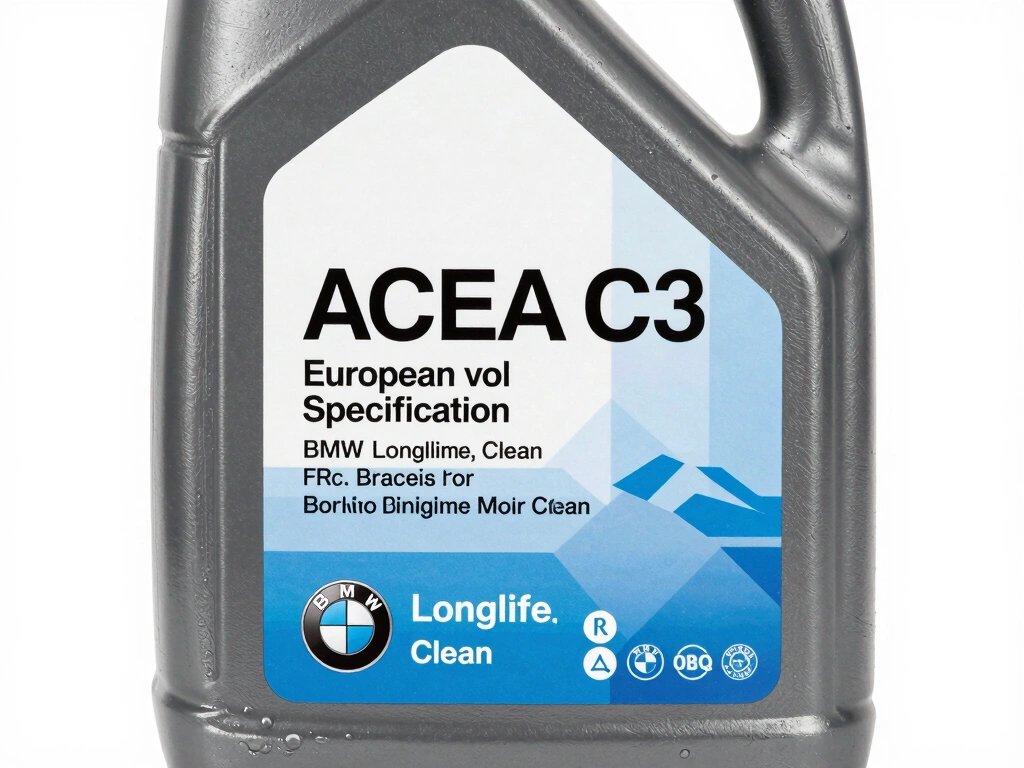
Cross-reference the oil label. On the back or side label of any ACEA C3 oil, look for the specific OEM approval codes relevant to your vehicle. “ACEA C3” alone is necessary but not always sufficient — some OEMs require their specific proprietary code on top of C3.
For context on how the API system works alongside ACEA and where the two specifications overlap, the API SP motor oil guide covers the US certification structure. For choosing the right oil across all the relevant criteria, the how to choose motor oil guide covers the full decision framework.
ACEA C3 vs. Other ACEA C Categories
C1: Lowest SAPS, thinner HTHS viscosity (minimum 2.9 cP). Used in specific European applications where maximum DPF life and fuel economy are prioritized over film thickness. Less common than C3.
C2: Low-SAPS with HTHS minimum 2.9 cP. Used in some PSA (Peugeot/Citroën) and Ford European diesel applications. Thinner than C3 at operating temperature.
C3: Mid-SAPS with HTHS minimum 3.5 cP. The most widely specified across BMW, Mercedes-Benz, Volkswagen Group, Volvo, and others. The default choice when your European vehicle specifies ACEA C-category without a lower number.
C4: Mid-SAPS (slightly different phosphorus and sulfur limits than C3) with HTHS minimum 3.5 cP. Used in specific Renault and some Nissan/Infiniti applications.
C5 / C6: Newer ultra-low viscosity categories (0W-20, 0W-16) for maximum fuel economy with DPF compatibility.
If your vehicle specifies C3, do not use C1 or C2. The lower HTHS viscosity of C1/C2 means a thinner oil film at operating temperature — not what bearings engineered around C3’s 3.5 cP minimum need.
Related Articles
- How to Choose the Right Motor Oil for Your Car
- API SP Motor Oil Ratings: What the Certification Means
- Best Oil for Turbocharged Engines: What Actually Protects a Turbo
Frequently Asked Questions
Is ACEA C3 the same as API SP?
No. They are parallel specifications from different standards bodies with different requirements. API SP is the US standard; ACEA C3 is the European standard for catalyst-compatible oils. The key difference is SAPS limits: ACEA C3 restricts sulfated ash, phosphorus, and sulfur to protect catalytic converters and diesel particulate filters — limits that API SP does not impose. An oil can meet one without meeting the other, and European vehicles that specify ACEA C3 need an oil that carries that specific approval.
Which cars require ACEA C3 motor oil?
Most modern BMW, Mercedes-Benz, Audi, Volkswagen, Volvo, and many other European brands specify ACEA C3 — particularly those with diesel particulate filters or specific performance requirements. The exact requirement is vehicle-specific: check the oil filler cap, owner’s manual, or the OEM’s online approval database. European vehicles manufactured after approximately 2004–2010 that have diesel engines with DPF systems almost universally require a low-SAPS specification, which means ACEA C3 or lower.
Can I use 5W-30 ACEA C3 instead of 5W-40?
Only if your vehicle’s OEM specification permits the 5W-30 viscosity grade. ACEA C3 covers both 5W-30 and 5W-40 variants — the C3 designation describes SAPS limits and HTHS minimums, not the viscosity grade. If your vehicle specifies 5W-40 ACEA C3 (common in BMW M-series and older Mercedes V8s), using a 5W-30 ACEA C3 substitutes the wrong operating viscosity even though it carries the correct C3 approval. Viscosity grade and specification code are both required.
Why can’t I find ACEA C3 oil at AutoZone?
Most US auto parts retailers stock primarily API-certified oil formulated for the domestic market. ACEA C3 oils are typically sold through European vehicle dealerships, specialist retailers (ECS Tuning, FCP Euro, Pelican Parts), and online. Major brands like Castrol, Valvoline, and Liqui-Moly produce ACEA C3 versions of their products but under different SKUs than what fills the AutoZone shelf space — the professional or European vehicle variants.
Related Articles

Motor Oil Color Chart: What Each Color Tells You About Your Engine
Use this motor oil color chart to read your dipstick — from normal amber to dangerous milky white — and know exactly when to stop driving.
Best Synthetic Motor Oils 2026 (Tested and Ranked)
The best synthetic motor oil for most drivers is Mobil 1 Advanced Full Synthetic. Here's how 6 top brands compare — plus which to buy for your engine.
Why Is My Car Burning Oil? Common Causes and What to Do
Why is my car burning oil? Two causes: valve stem seals and piston rings. Here's how to tell which one and what to do about it.