API SP Motor Oil Ratings: SP, SN Plus, and ILSAC GF-6 Explained
API SP replaced SN Plus in 2020. ILSAC GF-6A and GF-6B cover newer thin-oil engines. Here's which certification your car actually needs and why.
Contents
The auto parts store has the same grade oil in two versions: one labeled API SP for $27, another labeled API SN Plus for $20. The SN Plus bottle looks newer but costs less. Do you save $7?
The answer: get the SP. API SP motor oil is the current standard for gasoline engines, and it replaced SN Plus for good reasons. Here’s why, and why understanding the API rating system saves you from this decision in the future.
How the API Rating System Works
The API (American Petroleum Institute) maintains the engine oil quality certification system for gasoline passenger car oils in the US. The system uses a letter progression: the further along in the alphabet, the newer and more demanding the specification.
Current ratings in the gasoline (S-category, for “spark ignition”) series, from newest to oldest:
| API Rating | Year Introduced | Status |
|---|---|---|
| SP | 2020 | Current — use this |
| SN Plus | 2018 | Superseded by SP |
| SN | 2010 | Older — acceptable for engines it was designed for |
| SM | 2004 | Older |
| SL | 2001 | Older |
| SJ | 1996 | Older |
Each new rating is backwards compatible — API SP meets or exceeds the requirements of SN Plus, SN, SM, and all earlier ratings. If your car was designed when SN was current, API SP oil is a direct drop-in upgrade. The reverse is not true: SN Plus doesn’t meet SP’s requirements, and shouldn’t be used in an engine designed for SP.
The “S” stands for spark ignition. There’s a parallel “C” system for diesel (“compression ignition”) engines, which uses different letter progression (CJ-4, CK-4, FA-4) — that’s a separate certification system entirely.
What API SP Actually Requires (Why It Matters)
API SP was introduced in 2020 specifically to address two failure modes that became critical in modern engines: LSPI (Low Speed Pre-Ignition) and timing chain wear in turbocharged GDI engines.
LSPI is a potentially engine-destroying combustion event in turbocharged direct-injection engines. Unlike traditional knock, LSPI occurs at low RPM and high load — pulling away from a stop in a turbo four-cylinder is the classic scenario. Certain oil formulations interact with the fuel charge in ways that trigger spontaneous pre-ignition. The result is combustion pressure spikes that can bend connecting rods or crack pistons. API SP certification includes LSPI test requirements (the Sequence IX test) that SN Plus and SN do not include.
Timing chain wear in turbocharged GDI engines became a specific concern as manufacturers thinned engine components to save weight and improve fuel economy. API SP includes the Sequence X timing chain wear test. This wasn’t in the SN Plus spec.
Other SP requirements:
- Sludge and deposit resistance (stricter than SN)
- Oxidation stability at high temperatures
- Fuel economy retention over service life
API SN Plus: The Stopgap That SP Replaced
API SN Plus was introduced in 2018 as a temporary measure to address LSPI concerns in turbocharged GDI engines before the full SP specification was ready. It’s exactly what the name suggests — SN with an additional LSPI protection test grafted on.
SN Plus is better than SN for LSPI-susceptible engines. But it lacks the timing chain wear test and several other improvements that SP introduced in 2020. For any engine manufactured in the last five years, SP is the correct specification.
When might SN Plus still be acceptable? Only in one scenario: a pre-2020 naturally aspirated engine whose manufacturer specified SN, in a situation where you have a substantial supply of SN Plus oil you purchased before SP became widely available. For any new purchase, SP is the correct choice even for older engines — it’s backwards compatible and provides better protection.
The discounted SN Plus at the auto parts store is priced down because it’s outdated stock being cleared. That’s your cue, not a deal.
ILSAC GF-6A and GF-6B: The Fuel Economy Certifications
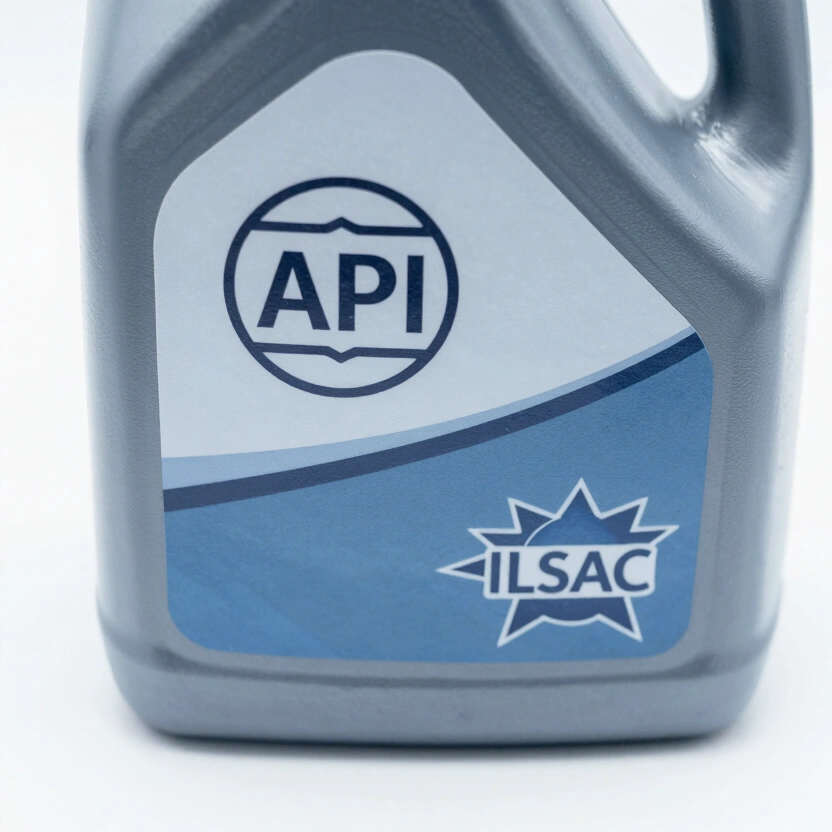
ILSAC (International Lubricant Standardization and Approval Committee) is a joint body of US and Japanese automakers — Ford, GM, Chrysler, Toyota, Honda — that maintains a parallel certification system focused on fuel economy performance alongside engine protection. ILSAC certification is displayed as the “starburst” symbol on oil bottles.
The current ILSAC specifications:
ILSAC GF-6A (introduced 2020, same timing as API SP):
- Covers 0W-20, 0W-30, 5W-20, 5W-30, and higher viscosity grades
- Includes API SP engine protection requirements
- Adds fuel economy test (Sequence VIH test) and fuel economy retention
- Required for most OEM specifications from Toyota, Honda, GM, Ford that list ILSAC GF-6
ILSAC GF-6B (introduced 2020):
- Covers exclusively 0W-16 viscosity grade
- Designed for next-generation ultra-low-viscosity engines (some Toyota and Honda applications)
- Requires API SP protection levels in the 0W-16 grade
- Not interchangeable with GF-6A — different viscosity range, different test sequence
The practical difference between API SP and ILSAC GF-6A: Both cover current engine protection requirements. GF-6A adds verified fuel economy performance testing. For most drivers, an oil certified to both API SP and ILSAC GF-6A (common on most name-brand full synthetics) covers everything. If your owner’s manual specifies an ILSAC rating specifically, look for the starburst symbol.
Which Rating Does Your Specific Car Need?
Modern vehicles (2020+): API SP is the correct rating. Check the oil cap — if it says “API SP” or lists “SP” in the service requirements, that’s the specification. Most current full synthetics from major brands (Mobil 1, Castrol, Pennzoil, Valvoline) are API SP and ILSAC GF-6A certified.
GM vehicles (2021+): Beyond API SP, GM specifies dexos1 Gen 3 — their proprietary standard that requires API SP compliance plus additional GM-specific performance requirements. Look for “dexos1 Gen 3” licensing on the bottle, not just API SP. Mobil 1 carries this approval for most grades.
European vehicles: ACEA ratings (the European equivalent) matter here — BMW Longlife-04, Mercedes-Benz 229.3/229.5, VW 502.00/504.00. These OEM-specific approvals are printed on bottles that meet them. API SP is a baseline; European OEM codes are additive requirements beyond that baseline.
Older vehicles (pre-2010, naturally aspirated): API SN meets the original design specification. API SP is backwards compatible and perfectly acceptable. No performance reason to specifically seek SN if SP is the available option at the same price.
Toyota and Honda (current models): Most current Toyota and Honda applications specify API SP motor oil meeting ILSAC GF-6A. Check the owner’s manual or oil cap — if it says “ILSAC GF-6” or shows the starburst symbol requirement, you want a bottle with that certification. Most major brand full synthetics carry it.
Vehicles with the 0W-16 spec: Some late-model Toyota and Honda applications specify 0W-16 meeting ILSAC GF-6B. This is a narrow, specific requirement — only ILSAC GF-6B certified 0W-16 oil is correct for these engines.
How to Read the API Donut
The API “donut” symbol appears on the front or back of most oil bottles sold in the US. Reading it:
Top section (arc): “API SERVICE” — confirms this is an API-certified product Center: The service rating — “SP” for the current gasoline standard Bottom section (arc): Energy conserving claim, if applicable — means the oil passed fuel economy testing (ILSAC GF-6A equivalence) Surrounding circle: SAE viscosity grade — “5W-30”, “0W-20”, etc.
If the center of the donut doesn’t say “SP,” you’re looking at an older-stock or lower-tier product. The donut is the fastest reference on the shelf.
The ILSAC starburst symbol is typically printed near the donut — it’s a separate certification from a separate organization, but the two almost always travel together on current full synthetic products meeting API SP + GF-6A.
For the full walkthrough of what each element on a motor oil label means, the how to read a motor oil label guide covers the SAE grade, API donut, starburst, and OEM approval codes in one read. For choosing the right oil for your specific vehicle using these ratings, the motor oil selection guide has the complete decision framework.
API SP Certified Full Synthetics


* Affiliate links. Prices last updated March 6, 2026.
Related Articles
- Dexos1 Motor Oil: What Every GM Owner Needs to Know
- ACEA C3 Motor Oil: What It Means and Which Oils Actually Meet It
- Best Motor Oil for GDI Engines: What LSPI Protection Actually Means
Frequently Asked Questions
Is API SP the same as SN Plus?
No. API SP replaced SN Plus in 2020 and is a more demanding specification. SP adds timing chain wear testing (Sequence X) and stricter LSPI protection requirements that SN Plus doesn’t include. API SP is backwards compatible with SN Plus and earlier ratings — an SP-certified oil meets everything SN Plus required, plus additional requirements.
Do I need API SP if my car is older?
API SP is backwards compatible with all earlier API S-series ratings. Using API SP oil in an older engine that originally called for SN, SM, or SL is fine — the newer oil meets and exceeds those older specifications. If your old manual says “API SL minimum,” API SP satisfies that requirement.
What does ILSAC GF-6A mean on the bottle?
ILSAC GF-6A certifies that the oil meets API SP engine protection standards plus verified fuel economy performance. It’s issued jointly by US and Japanese automakers (Ford, GM, Toyota, Honda, Chrysler). GF-6A covers viscosity grades 0W-20, 5W-20, 5W-30, 0W-30, and similar. GF-6B is a separate category covering only 0W-16 grade for ultra-thin-viscosity engine applications.
Can I use API SP in my GDI turbocharged engine?
Yes — API SP specifically addresses the failure modes of GDI turbocharged engines, including LSPI and timing chain wear. SP certification means the oil passed both the Sequence IX LSPI test and the Sequence X timing chain test. For GM vehicles specifically, you also need dexos1 Gen 3 licensing (which requires API SP compliance as a baseline).
What’s the difference between the API donut and ILSAC starburst?
They’re certifications from different organizations. The API donut confirms the oil passed API’s standardized engine testing battery (currently SP for gasoline engines). The ILSAC starburst confirms the oil met ILSAC’s fuel economy and engine protection requirements (currently GF-6A). Most current full synthetics carry both certifications, as the test requirements substantially overlap. If your OEM specification lists an ILSAC rating, look for the starburst.
My oil cap says “API SP” but my old oil says “API SN” — can I mix them?
Yes, chemically safe. API-rated oils use compatible additive chemistries regardless of generation. Topping off SP oil with SN (or vice versa) creates a functional oil somewhere between the two specifications in terms of additive package. Not ideal as a long-term strategy — you want a consistent formulation — but mixing in an emergency or during a top-off won’t cause a chemical reaction or engine damage.
Related Articles
ACEA C3 Motor Oil: What It Means and Which Oils Actually Meet It
ACEA C3 motor oil is the European standard for petrol and diesel engines with emissions equipment. What the spec requires and which oils carry it.

Motor Oil Color Chart: What Each Color Tells You About Your Engine
Use this motor oil color chart to read your dipstick — from normal amber to dangerous milky white — and know exactly when to stop driving.
Best Synthetic Motor Oils 2026 (Tested and Ranked)
The best synthetic motor oil for most drivers is Mobil 1 Advanced Full Synthetic. Here's how 6 top brands compare — plus which to buy for your engine.