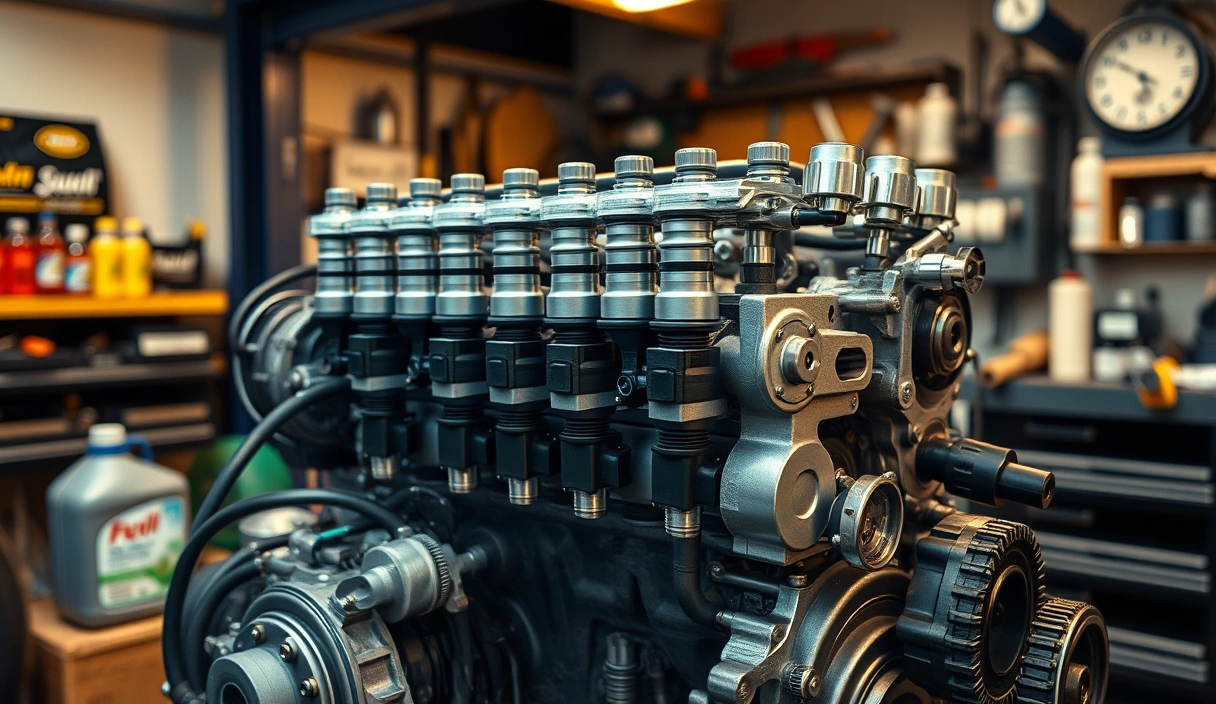
Best Motor Oil for GDI Engines: What LSPI Protection Actually Means
Best motor oil for GDI Engines requires API SP with LSPI protection. Here's what that means, which oils qualify, and what to avoid.
Contents
The failure mode starts without warning. At low RPM under load — pulling away from a stop, merging onto a highway — a droplet of fuel or oil mist in the combustion chamber ignites spontaneously before the spark plug fires. The resulting pressure spike arrives as a shockwave, not a gradual build. Connecting rods bend. Pistons crack. It’s not the slow grinding of wear-based failure — it’s structural damage in a single combustion event.
This is Low-Speed Pre-Ignition (LSPI), and it’s the reason picking the best motor oil for GDI Engines isn’t a casual decision. Turbocharged GDI Engine designs are the dominant powertrain in new vehicles sold today — if you’re driving anything from a Ford F-150 with the 2.7L EcoBoost to a Honda Civic Si — you’re driving a GDI Engine, and the oil formulation you use either contains LSPI inhibitors or it doesn’t.
Here’s what the chemistry actually involves, which oils include it, and what to look for on the label.
Why GDI Engines Are Different
A Gasoline Direct Injection engine injects fuel directly into the combustion chamber at high pressure — between 1,500 and 3,600 psi in modern systems — rather than into the intake port as port fuel injection does. This allows precise fuel metering, higher compression ratios, and turbocharging at smaller displacements. The result is more power and better fuel economy from a smaller engine.
The tradeoff is a more demanding lubrication environment:
Higher combustion temperatures. The compressed charge in a turbocharged GDI cylinder runs hotter than in a naturally aspirated engine. Oil film on cylinder walls and combustion chamber surfaces is exposed to higher peak temperatures.
Fuel dilution. Direct injection fuel systems can allow small amounts of raw fuel past piston rings, especially on short-trip cold-start cycles. Fuel in the crankcase dilutes the oil and reduces viscosity and film strength at operating temperature.
LSPI sensitivity. The conditions that allow LSPI — calcium-heavy detergent additives interacting with high-pressure fuel droplets in the combustion chamber — are more prevalent in turbocharged GDI Engines because the combustion environment is more complex than in naturally aspirated engines.
Timing chain wear. Higher operating loads and temperatures accelerate wear on timing chains in GDI Engines. API SP added a specific timing chain wear test (Sequence X) for this reason.
What “LSPI Protection” Actually Means on the Label
The specification that addresses LSPI in motor oil is API SP, introduced in 2020. The API SP spec requires passing the Sequence IX test — a standardized LSPI evaluation in a turbocharged GDI Engine. An oil that carries API SP certification has passed this test. An oil with API SN or SN Plus (which preceded SP) has either passed a less rigorous version of the test or no LSPI test at all.
The chemistry behind LSPI protection matters as much as the test result. Research identified calcium-based detergents — common in earlier oil formulations — as a primary LSPI trigger when calcium-rich oil droplets enter the combustion chamber and serve as ignition points. API SP-certified oils reformulate the detergent package, reducing calcium content and replacing it with magnesium-based detergents, which don’t trigger the same pre-ignition reaction.
This means the label distinction is meaningful. An older API SN oil in a GDI Turbocharged Engine isn’t just “less good” than an API SP oil — it may actively contribute to LSPI events through its additive chemistry. The API SP upgrade is a legitimate engineering improvement, not a marketing revision.
For the full breakdown of API rating history and what each certification requires, the API SP motor oil guide covers the Sequence IX and Sequence X tests in detail.
Best Motor Oil for GDI Engines
Any API SP Full Synthetic Oil in the OEM-specified viscosity grade covers the LSPI protection requirement. These four options represent the mainstream choices with strong certification documentation and wide availability:
API SP Full Synthetics for GDI Engines


* Affiliate links. Prices last updated March 6, 2026.
Mobil 1 Advanced Full Synthetic 5W-30: API SP and ILSAC GF-6A certified. Mobil reformulated for SP specifically around magnesium-boosted detergents that lower LSPI risk. Long track record in turbocharged applications. Published product data sheet available for verification.
Valvoline Advanced Full Synthetic 5W-30: API SP / ILSAC GF-6A. Valvoline’s test data claims 40% better wear protection and 25% better deposit control than the API SP minimum. Available at most major retailers and on Amazon. Commonly recommended in GDI owner communities for Civic Si, Mazda CX-5, and similar applications.
Pennzoil Platinum Full Synthetic 5W-30: API SP / GF-6A. Shell’s PurePlus Gas-to-Liquid base stock starts from natural gas rather than crude oil, resulting in a purer Group III base with fewer impurities. The resulting additive package has more room to work with, and Shell’s LSPI claims in their own testing are strong.
For the full motor oil decision framework including how to match viscosity and certification to your specific vehicle, the motor oil selection guide covers the complete process.
Viscosity: What Grade Your GDI Engine Needs
The viscosity grade is set by the OEM, not the oil formulation. For most modern turbocharged GDI Engines, that means:
0W-20 or 5W-20: Common in current Toyota, Honda, and Mazda GDI applications. Lower viscosity reduces cold-start friction and fuel consumption. These grades require ILSAC GF-6A (for 5W-20 and 0W-20) or GF-6B (for 0W-16 in some Toyota/Honda applications).
5W-30: Common in Ford EcoBoost, GM turbocharged four-cylinders, and many European GDI applications. Slightly thicker at operating temperature, which suits the higher operating loads in these engines.
0W-30 or 5W-40: Some European GDI applications with ACEA C3 or OEM-specific approvals (BMW Longlife-04, VW 504.00) require a grade in this range. API SP alone doesn’t cover European OEM codes — those require additional certification on the bottle.
The rule: use the grade on the oil cap and in the owner’s manual. Going thicker than specified adds cold-start friction and can restrict oil flow to timing chain tensioners — the opposite of what a GDI Engine needs on startup.
Oil Change Intervals for GDI Turbocharged Engines
The standard 7,500–10,000 mile Full Synthetic interval is appropriate for GDI Engines under normal driving — commuting, mixed highway/city, moderate temperatures. A few conditions call for shortening it:
Short-trip driving. If most of your trips are under 5 miles, the engine rarely reaches the temperature needed to burn off combustion moisture and fuel dilution products. Fuel dilution accumulates faster in short-trip GDI driving than in the same pattern for a naturally aspirated engine. Shorten to 5,000 miles if short-trip driving is the primary use case.
Extended high-load cycles. Regular towing or sustained mountain driving puts more thermal and mechanical stress on GDI oil. Turbocharged engines running at high boost for extended periods heat the oil faster. Consider 5,000–7,500 miles under these conditions.
Checking for fuel dilution. If you want to verify whether your GDI Engine has a fuel dilution issue, used oil analysis from a lab like Blackstone will flag elevated fuel percentage in the sample. A consistent fuel percentage above 2–3% suggests shortening the interval until the cause is identified.

Carbon Buildup and Timing Chain Wear in GDI Engines
LSPI protection is the headline concern, but two secondary issues matter for long-term GDI Engine health:
Intake valve carbon deposits. In port-injected engines, fuel spray helps wash the intake valves. In direct injection, fuel never touches the valves — oil vapor from the PCV system is the primary deposit source. High-detergent oil slows deposit accumulation, but it can’t eliminate it. Walnut blasting (walnut shell media blasted through the intake ports) is the definitive service, typically needed every 40,000–60,000 miles on high-deposit GDI Engines.
Timing chain wear. API SP’s Sequence X timing chain test was added specifically because GDI Engines showed accelerated timing chain wear compared to earlier designs. High-quality API SP Full Synthetic Oil passes this test, meaning the additive package maintains adequate film strength at the timing chain surfaces under GDI operating conditions. Conventional oil or older API SN oil has not been evaluated under this test.
Related Articles
- Best Synthetic Motor Oil: Top Full Synthetic Picks Compared
- API SP Motor Oil Ratings: SP, SN Plus, and ILSAC GF-6 Explained
- How to Choose Motor Oil: The Complete Decision Guide
Frequently Asked Questions
Can I use API SN Plus oil in my GDI Turbocharged Engine?
API SN Plus was designed as a partial answer to LSPI before API SP was finalized in 2020. It includes an LSPI test, but not the timing chain wear test (Sequence X) that SP added. For a modern GDI Engine, API SP is the current correct specification. SN Plus is an older standard — using it isn’t catastrophic, but it’s not what the engine was designed for and doesn’t cover all the failure modes that SP was created to address.
What viscosity does my GDI Turbocharged Engine need?
Check the oil cap and owner’s manual — the OEM specification is the answer. Most Ford EcoBoost and GM turbocharged four-cylinders specify 5W-30. Most current Toyota and Honda GDI applications specify 0W-20. Some European turbocharged GDI Engines require 0W-30 or 5W-40 with OEM-specific certifications (BMW LL-04, VW 504.00) that go beyond API SP.
How often should I change oil in a turbocharged GDI Engine?
7,500 miles under normal driving with API SP full synthetic. Shorten to 5,000 miles if you primarily make short trips (under 5 miles), frequently tow, or live in a climate with extreme temperature swings. Turbocharged engines particularly benefit from shorter intervals during the break-in period (first 10,000 miles) when clearances are still settling.
Does API SP fully protect against LSPI?
API SP certification means the oil passed the Sequence IX LSPI test at the threshold required by the standard. It doesn’t mean zero LSPI risk in all conditions — LSPI is also affected by fuel quality, injector condition, and combustion chamber deposits. API SP oil with the correct viscosity is the oil-side of the equation. Using the OEM-recommended fuel octane rating and keeping up with induction system cleaning covers the rest.
Is full synthetic required for GDI Engines, or can I use synthetic blend?
Most current GDI Engine OEMs specify full synthetic. Synthetic blend typically carries API SP certification in the same grades, so the LSPI protection requirement can be met — but the drain interval is shorter, and the thermal stability at sustained high-load turbo temperatures isn’t as strong. For a GDI Engine used normally, full synthetic is the correct choice and the one the OEM engineered for.
Related Articles
Best Synthetic Motor Oils 2026 (Tested and Ranked)
The best synthetic motor oil for most drivers is Mobil 1 Advanced Full Synthetic. Here's how 6 top brands compare — plus which to buy for your engine.
Best Oil for Turbocharged Engines: What Actually Protects a Turbo
The best oil for turbocharged engines is full synthetic API SP — brand and viscosity matter too. Here's what turbos need and which oils deliver it.
API SP Motor Oil Ratings: SP, SN Plus, and ILSAC GF-6 Explained
API SP replaced SN Plus in 2020. ILSAC GF-6A and GF-6B cover newer thin-oil engines. Here's which certification your car actually needs and why.