
Engine Oil Viscosity Explained: What 0W-20 Actually Means
0W-20, 5W-30, 10W-40: the numbers on your oil cap follow a specific system. Here's what each part means, why it matters, and how to read it.
Contents
Pull the oil cap off any car built in the last thirty years. The cap has a number stamped on it: 5W-30, 0W-20, 10W-40, something along those lines. Engine oil viscosity explained simply: that number is a standardized specification from SAE International, and every digit means something specific about how that oil behaves in your engine at cold temperatures and at full operating temperature.
Here’s how to read it, part by part.
The “W” Is Not “Weight” — It’s Winter
The most common misconception: people assume the W stands for “weight.” It stands for Winter, and the number before it is a cold-temperature flow rating.
SAE International — the Society of Automotive Engineers, the organization that sets these specifications — tests engine oils at low temperatures and rates their cold-flow performance. A 0W oil flows better in extreme cold than a 5W oil, which flows better than a 10W, and so on.
Practically: the lower the W number, the faster the oil circulates when you start a cold engine. Most engine wear happens in the first 30 seconds after cold startup, when oil hasn’t fully circulated to bearings and valve train surfaces. An oil that reaches those surfaces faster provides more protection in that critical window.
The W ratings map roughly to minimum temperature performance:
| W Rating | Minimum Temp Performance |
|---|---|
| 0W | -40°F (-40°C) |
| 5W | -22°F (-30°C) |
| 10W | -4°F (-20°C) |
| 15W | 14°F (-10°C) |
| 20W | 23°F (-5°C) |
If you live in Minnesota and park outside all winter, there’s a real performance difference between 0W and 5W at cold startup. If you live in Phoenix, the W number matters very little — your “cold” starts are already in the 60–70°F range, where all modern oil grades flow freely.
The Number After the Dash: Operating Temperature Viscosity
The second number — the 20 in 5W-20, or the 30 in 5W-30 — is the oil’s high-temperature viscosity rating. SAE measures this at 100°C (212°F), which approximates engine operating temperature.
A 30-grade oil is thicker at operating temperature than a 20-grade oil. Thicker means:
- Higher film pressure in bearing clearances
- Slightly more resistance to oil pump flow (small fuel economy penalty)
- More protection margin in worn or high-clearance engines
A 20-grade oil is thinner at operating temperature. Thinner means:
- Faster oil flow to tight bearing clearances in precisely machined modern engines
- Lower oil pump load (small fuel economy improvement)
- Less protection margin if the engine has loose tolerances or significant wear
Neither is universally better. Your engine was designed and machined for a specific operating viscosity. The OEM chose the number based on measured bearing clearances, pump geometry, and their testing across temperature ranges. Running the specified grade is the correct choice — not the thicker one, not the thinner one.
Common high-temperature grades and their typical applications:
| Grade | Typical Applications |
|---|---|
| 20 (0W-20, 5W-20) | Modern Toyota, Honda, Ford EcoBoost, post-2015 GM |
| 30 (0W-30, 5W-30) | Most European vehicles, Subaru, older GM, most turbo engines |
| 40 (5W-40, 10W-40) | European performance vehicles, BMWs specifying Longlife-04, Diesel engines |
| 50 (5W-50, 10W-50) | Track use, high-output naturally aspirated engines, hot climates with older engines |
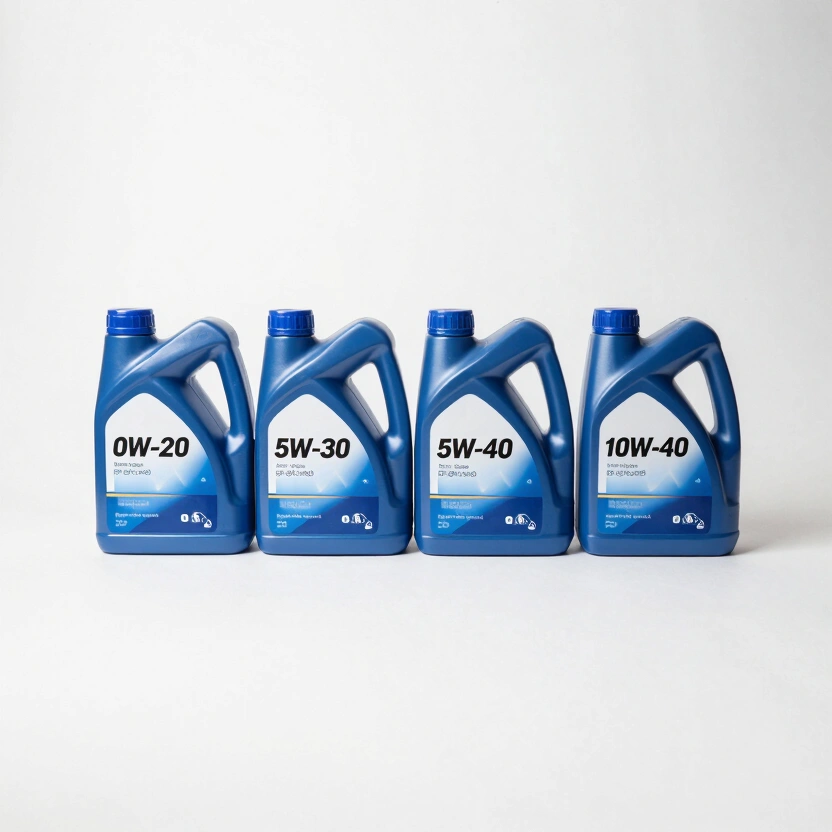
How One Oil Can Be Both Thin and Thick: Viscosity Index Improvers
Here’s the part that seems contradictory: a 5W-30 oil acts like a thin 5W oil at freezing temperatures but maintains the viscosity of a 30-grade oil at operating temperature. How does the same fluid do both?
The answer is Viscosity Index Improvers (VIIs) — polymer additives that change their molecular shape with temperature. At low temperatures, VII molecules coil tightly into compact chains, allowing the base oil to flow freely with minimal resistance. As temperature rises, those polymer chains uncoil and expand, thickening the oil’s effective viscosity. The result is an oil that’s thin when cold and appropriately thick when hot.
The viscosity index number (usually listed on product data sheets, not on the bottle) measures how much an oil’s viscosity changes with temperature. A high viscosity index means the oil maintains more consistent thickness across temperature extremes — which is exactly what VIIs are engineered to achieve.
One important caveat: VIIs are polymers, and polymers shear. Under the mechanical stress of engine operation — through high-pressure oil passages, between gear teeth, across bearing surfaces — those polymer chains gradually break into shorter segments. A shorter polymer chain doesn’t expand as much at operating temperature. Over the course of a drain interval, a 5W-30 can effectively drift toward 5W-25 or even lower as the VII package shears down. This is one reason drain intervals have upper limits: even if the base oil hasn’t oxidized, the viscosity modifier has degraded enough that the oil no longer meets its stated grade.
Synthetic base oils (Group III and IV) have a higher natural viscosity index than conventional petroleum, which means they require fewer VIIs to achieve the same multi-grade behavior. Fewer VIIs means less shear degradation over the drain interval, which is part of why full synthetic maintains its rated grade longer than conventional oil.
Reading a Full Grade Designation
A complete oil grade designation reads like this:
5W-30
- 5: Cold-weather performance. This oil was tested by SAE at low temperatures and passed the 5W cold-crank and cold-pump tests.
- W: Winter. This number refers to cold-temperature performance.
- 30: High-temperature viscosity at 100°C. This oil maintains a kinematic viscosity in the range SAE specifies for the 30-grade classification.
A 0W-20 oil has excellent cold-weather flow (0W rating, best available for most passenger cars) and thinner-than-average operating viscosity (20-grade). It’s engineered for modern precisely-machined engines that need fast cold-weather circulation and benefit from reduced fluid drag at operating temperature.
A 10W-40 oil has moderate cold-weather flow (10W rating — acceptable in mild climates but not ideal in severe cold) and thicker-than-average operating viscosity (40-grade). You’ll see it in older engines with wider tolerances, diesel applications, or as a recommendation from manufacturers operating in hotter ambient climates.
How OEMs Select Viscosity Grades
Engine designers don’t pick viscosity grades arbitrarily. The selection follows from specific engineering measurements:
Bearing clearances are the primary driver. The gap between a crankshaft journal and its bearing shell is measured in thousandths of an inch. A larger gap needs a thicker oil film to maintain hydrodynamic pressure — the microscopic wedge of oil that keeps metal surfaces separated. A tighter gap can work with a thinner film. Modern CNC machining produces much tighter tolerances than engines from twenty years ago, which is why 0W-20 is now the OEM specification for engines that would have used 5W-30 in the past.
Oil pump efficiency is a secondary factor. Thinner oil takes less energy to pump, which translates to measurable fuel economy improvements. OEMs — especially those with CAFE fuel economy standards to meet — have strong incentive to specify the thinnest oil that provides adequate protection. This is why you’ve seen a general trend toward 0W-20 and even 0W-16 in recent OEM specifications.
Temperature operating range rounds out the selection. An engine that sees sustained 250°F+ oil temperatures (track use, sustained towing) needs higher operating viscosity to maintain film strength at those temps. An engine running short suburban trips that rarely reach full operating temperature benefits from lighter grades that circulate faster during the majority of its cold-start operation.
When Grade Matters Most
For most drivers running the specified grade at normal intervals: viscosity grade choice is straightforward — use what the cap says. The situations where understanding the grade system pays off:
If you’re choosing between two OEM-specified options. Some vehicles list two grades: “5W-20 recommended, 5W-30 acceptable.” In cold climates, 5W-20 is the better choice (faster cold-start circulation). In hot climates running the engine hard, 5W-30 provides more thermal margin.
If you’re running extended drain intervals. A fresh 5W-30 starts the interval at full grade. After 10,000+ miles, VII shear degradation has reduced it somewhat. Starting with the correct grade means finishing closer to the correct grade. Starting with a thinner grade means finishing in borderline territory.
If the store is out of your specified grade. For a single change, one grade off (5W-30 in a 5W-20 engine) is acceptable. For regular use, the detailed breakdown of 5W-30 vs. 5W-20 covers what the long-term effects actually look like.
For viscosity grade selection as part of a broader oil choice — whether to use synthetic vs. conventional and which brand meets your OEM’s approvals — the motor oil selection guide covers the full decision.
Top-Rated Oils by Viscosity Grade


* Affiliate links. Prices last updated March 6, 2026.
Frequently Asked Questions
What does the “W” mean in motor oil grades?
W stands for Winter, not “weight.” The number before the W is a cold-temperature performance rating measured by SAE International. A 0W rating means the oil flows better at low temperatures than a 5W or 10W. The lower the W number, the faster the oil circulates during cold starts.
What’s the difference between 0W-20 and 5W-30?
Both numbers have two components. The cold-weather performance (W rating) differs: 0W circulates slightly faster in sub-freezing temperatures than 5W. The operating temperature viscosity also differs: the 30-grade in 5W-30 is thicker at 100°C than the 20-grade in 0W-20. Engines specified for 0W-20 (many modern Toyota and Honda models) are machined for tighter bearing clearances that work optimally with the thinner film. Engines specified for 5W-30 have slightly wider clearances that need the thicker film.
Does a thicker oil grade protect the engine better?
Not universally. An engine designed for 0W-20 gets no additional protection from 5W-30 — the thicker oil doesn’t fill tight clearances more effectively, it just flows into them less freely. An engine designed for 5W-30 that runs 0W-20 loses some film thickness at operating temperature. “Better protection” means the grade matching the engine’s design specification, not the thicker available grade.
What are Viscosity Index Improvers and why do they matter?
Viscosity Index Improvers (VIIs) are polymer additives that enable multi-grade oil behavior. They coil tightly at low temperatures (allowing free cold-flow) and expand at high temperatures (increasing viscosity to the rated grade). Over a drain interval, mechanical stress shears these polymers into shorter segments that provide less thickening at operating temperature. This is why long-used oil can behave slightly thinner than its rated grade — and why synthetic base oils, which require fewer VIIs to achieve the same multi-grade behavior, maintain their rated grade more consistently over extended intervals.
Can I use a different viscosity grade in my car?
For a single oil change when your specified grade is unavailable: one grade off is acceptable. For regular ongoing use, use the grade specified in your owner’s manual or on the oil cap. Running the wrong grade long-term causes measurable wear in engines with tight bearing clearances (if grade is too thick) or borderline film strength at operating temperature (if grade is too thin).
Why have OEM specifications shifted toward lighter grades like 0W-20?
Two reasons. Modern CNC machining produces tighter bearing clearances than was possible in older engine production — tighter clearances work effectively with thinner films. The second reason is fuel economy: thinner oil takes less energy to pump, which translates to real CAFE fuel economy improvements. Both factors push OEM specifications toward lighter grades in modern engines. This doesn’t mean older grades are inferior — they’re correct for engines designed around them.
Related Articles
Related Articles

Engine Oil Sludge: Causes, Symptoms, and How to Fix It
Engine oil sludge can kill your engine silently. Learn what causes it, how to spot it, and the exact steps to flush and prevent it for good.

Engine Knocking From Low Oil: What the Sound Means and What to Do
Engine knocking from low oil is rod knock or lifter noise from oil starvation. How to diagnose it, what it means, and whether it's salvageable.

Is Your Engine Burning Oil? How to Tell for Sure
Burning oil symptoms are easy to miss until levels get critically low. Here's how to spot the signs early and what they tell you about your engine.