
How to Check Engine Oil: Level, Condition, and What to Look For
Checking engine oil takes two minutes and tells you everything about your engine's health. Here's exactly how to read the dipstick and what to look for.
Contents
Knowing how to check engine oil is a two-minute skill that most drivers skip until something goes wrong. Park the car. Wait ten minutes for the engine to cool. Pop the hood. The orange or yellow plastic loop near the front of the engine is the dipstick. Pull it out, wipe it off, push it back in all the way, pull it out again. Look at where the oil film stops on the stick. That’s a complete motor oil level check.
If you’ve never done it, you just learned it. The rest of this guide covers what the reading means, what to look for beyond just the level, and the situations where what you find on the stick should change your plans.
What You Actually Need
No tools required. What you need:
- A clean rag or paper towel
- 10 minutes for the engine to sit after shutting off (not strictly necessary at all oil temperatures, but cleaner readings come from cool oil)
- Adequate light — a phone flashlight works
That’s it. The dipstick, the wipe, the re-insert, the read. Two minutes total.
How to Check Engine Oil: Step by Step
Step 1: Park on level ground. The dipstick is designed to read correctly when the car is level. Parked on a significant slope, oil pools toward the low end of the pan and the reading will be off by a meaningful amount. A flat driveway or parking lot is all you need.
Step 2: Check engine temperature. You can check oil when the engine is warm or cold — both give valid readings. Cold oil reads slightly differently because it’s more viscous and coats the stick more evenly. Most mechanics check warm after a brief cool-down (5–10 minutes after shutting off). The oil has settled back into the pan, it’s thin enough to run off cleanly to show the level line, and it’s not so hot that it drips everywhere.
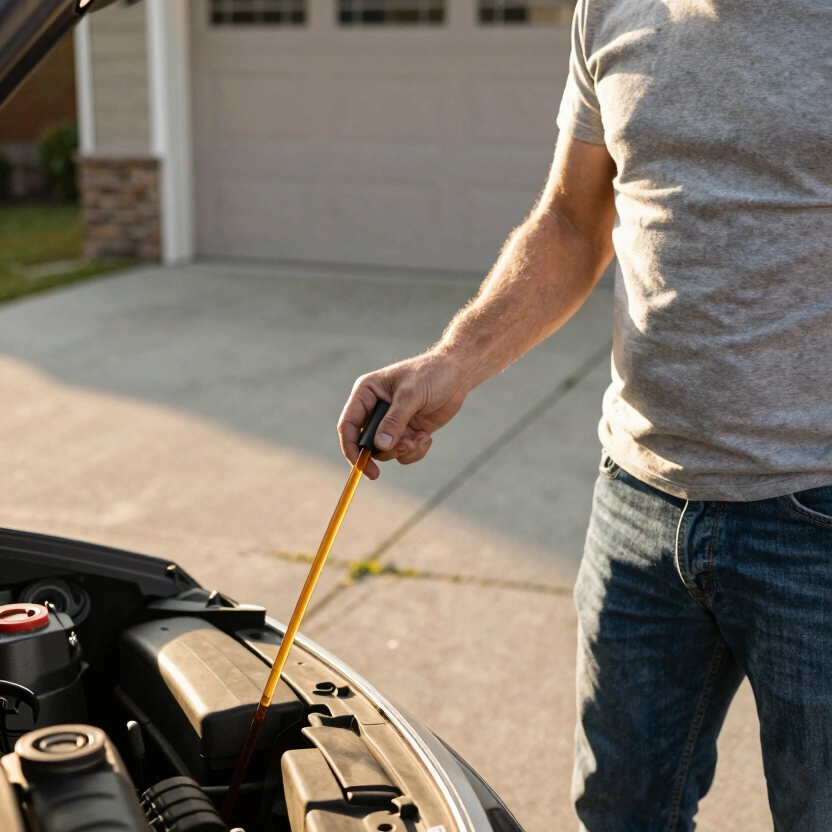
Step 3: Open the hood and locate the dipstick. On most cars, the dipstick has a brightly colored handle — orange, yellow, or red — designed to be found quickly. It’s usually near the front of the engine, inserted into a long thin tube that goes down into the oil pan. If you can’t spot it immediately, check the owner’s manual for a labeled engine diagram.
Step 4: Pull the dipstick out fully. A slow, smooth pull. The tube it sits in is usually curved, so angling slightly helps. Pull it completely free of the tube.
Step 5: Wipe it clean. Use the rag to wipe the entire metal portion of the dipstick from top to bottom. The first pull gives you a smeared reading from oil that ran down the tube during operation. You need a clean surface for an accurate second reading.
Step 6: Re-insert the dipstick fully. Push it back into the tube until it seats completely. The handle should be flush against the tube opening. If it doesn’t go in all the way, the reading will be low.
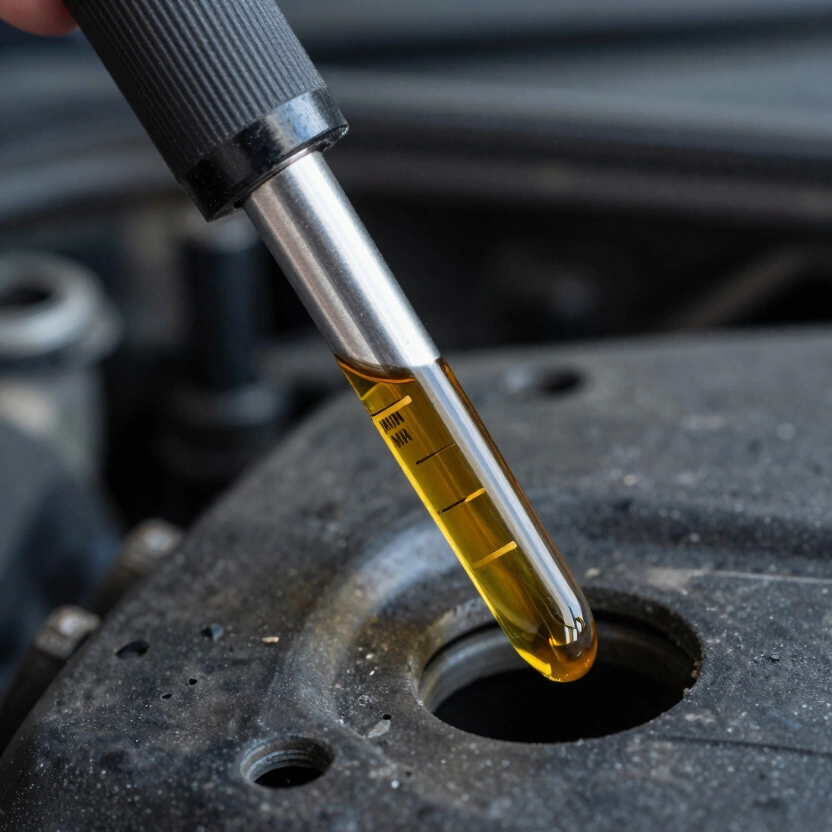
Step 7: Pull it out again and read the level. Hold the stick horizontally, with good light. The oil film will show on the metal portion with a distinct line where it ends. Look for the MIN and MAX marks (sometimes labeled LOW and FULL, or two dots/holes). The oil film line should fall between MIN and MAX, closer to MAX for a fresh fill.
Step 8: Note the level and put the dipstick back. If the level is between MIN and MAX, push the dipstick back in fully and close the hood. If it’s at or below MIN, add oil before driving. See the section below on what to add and how much.
Reading the Oil Level: What MIN and MAX Mean
The distance between MIN and MAX on most dipsticks represents approximately one quart of oil. If you’re at MIN, you need about a quart to reach MAX. If you’re halfway between them, add half a quart.
Don’t overfill past MAX. Oil above MAX gets whipped into foam by the crankshaft, which turns oil pressure into air pressure and reduces lubrication. An overfilled engine leaks more readily at seals and can hydrolock in extreme cases. The MAX mark is a ceiling, not a target — anywhere between MIN and MAX is fine.
If you need to add oil:
Open the oil filler cap — usually on top of the valve cover, labeled with an oil can symbol or the grade specification (5W-30, 0W-20). Pour in small amounts and recheck after a minute of settling. Adding a full quart when you’re half a quart low will overfill. Go slowly.
Use the same motor oil grade as what’s already in the engine. If you don’t know what’s in there, use what the oil cap specifies. If you need to top off with a different grade in an emergency (say, you’re on the road and only 5W-30 is available for a 0W-20 engine), that single-quart mix is not a crisis — just use the correct grade at the next full change.
What Normal Oil Looks Like on the Dipstick
Oil color and texture on the stick tell you more than just the level.
Normal (full synthetic, fresh to mid-interval): Amber to light brown, transparent when held to light, smooth coating with no particles.
Normal (older interval, conventional or approaching change): Dark brown to near-black, less transparent, still smooth. Dark oil doesn’t mean bad oil — combustion byproducts darken it quickly. Dark color alone isn’t a reason to change early.
Not normal — milky or gray color: This is coolant contamination, typically from a failed head gasket or cracked engine component. Coolant and oil mixing is serious. Stop driving and diagnose before continuing.
Not normal — foamy or bubbly texture: Overfilling, or coolant contamination. Either way, stop and investigate.
Not normal — gritty or grainy texture when you rub between fingers: Metal particles in the oil, indicating unusual wear. This warrants an oil analysis before the next change interval — how to read the signs covers what each condition means and when to act.
Viscosity breakdown is harder to detect visually. Oil that has reached the end of its service life may feel noticeably thinner when you rub it between your fingers compared to fresh oil — the Viscosity Index Improver polymers have sheared down under mechanical stress, and the base oil has partially oxidized. A fresh oil sample feels slightly more viscous and coherent. If you’re near the end of your change interval and the oil feels genuinely watery, change it.
How Often Should You Check?
Once a month is the right baseline for most vehicles. The specific scenario where more frequent checks matter: any vehicle you know consumes oil.
Normal engines lose less than one quart per 3,000 miles. If yours is burning a quart every 1,000–1,500 miles, monthly checks mean you catch the low level before it becomes a crisis. For actively consuming engines, check every 1,000 miles or every other fuel fill-up — whichever comes sooner.
Before long road trips: Always check before adding highway miles. A long drive that starts with oil a half-quart low can end with oil critically low at mile 500.
After recent oil work: Check within the first 200–300 miles after an oil change. Not because fresh oil disappears quickly, but because a loose drain plug or filter causes dramatic leaks that don’t make noise until they’ve emptied the pan.
The dashboard oil pressure warning light is not an oil level monitor. By the time that light comes on, oil pressure has already dropped below safe operating range. You’re watching for low level via the dipstick — the light is a last resort indicator that means stop immediately, not “change soon.”
Connecting Oil Condition to Change Timing
Checking motor oil regularly means you develop a feel for your engine’s condition between changes — how fast it darkens, how quickly the level drops, whether the texture changes. This baseline is more useful than any generic interval recommendation.
The how often to change your oil guide covers how to set an interval based on oil type, driving conditions, and what your oil monitor says — the dipstick check fills in the gaps between those intervals.
Top-Rated Oils for Checking and Maintaining Engine Health


* Affiliate links. Prices last updated March 6, 2026.
Frequently Asked Questions
How long after driving can I check my oil?
Ideally, wait at least 5–10 minutes after shutting off a warm engine. This lets oil drain back into the pan and settle to a stable level. You can check immediately after a cold start, but the level may read slightly lower than actual because some oil is still in passages. For the most consistent readings, check after a brief cool-down on a level surface.
Should I check oil with the engine hot or cold?
Either works. Warm oil (checked after a brief cool-down) gives the most consistent reading because it’s settled uniformly in the pan and thin enough to run off the dipstick cleanly to the level line. Cold checks are fine but the thicker oil can coat more of the stick, making the line slightly less distinct. Most manufacturer guidelines specify checking warm.
My oil is dark brown — do I need to change it?
Not necessarily. Oil darkens quickly from combustion byproducts — this is normal. A full synthetic that looks dark at 3,000 miles is doing its job correctly. The better signals for change timing are: the oil feels noticeably thinner than when fresh, the change interval is approaching per the manufacturer schedule, or the oil life monitor is reading low. Color alone doesn’t tell you when to change.
The dipstick reads between MIN and MAX — is that okay?
Yes, completely normal. Any level between MIN and MAX is acceptable. MAX is not required — it’s a ceiling. If you’re close to MIN, adding half a quart is a reasonable precaution. If you’re at or slightly above midpoint, nothing needs to happen until the next scheduled change or the next monthly check.
Can I mix different brands of oil when topping off?
Yes. All API-rated motor oils use compatible additive chemistry. Topping off a full synthetic with a different brand’s full synthetic — or even with a synthetic blend in a pinch — is chemically safe. It creates an effective mix between the two oils rather than a reaction. The result may slightly reduce the effective drain interval compared to running pure full synthetic, but for a quart top-off mid-interval, it’s not significant.
What if oil is above the MAX line?
Stop adding oil. If you’ve overfilled, some oil should be removed before driving. Excess oil above MAX gets whipped into foam by the crankshaft, which turns a full oil film into an air-oil mixture that provides inadequate lubrication and can cause seals to fail from excess pressure. A small amount over MAX — say, a half-inch — is borderline and often acceptable. A significant overfill is worth draining down.
Related Articles
- How to Choose the Right Motor Oil for Your Engine
- Signs It’s Time to Change Your Oil (Don’t Trust the Sticker)
- How Often Should You Change Your Oil? (The Real Answer)
- Overfilling Engine Oil: What Happens and How to Fix It
- Motor Oil Color Chart: What Each Color Tells You About Your Engine
- Best Synthetic Motor Oil: Top Full Synthetic Picks Compared
Related Articles

How to Read a Motor Oil Label: API, SAE & ILSAC Explained
Motor oil labels carry six pieces of information — most drivers decode one. Here's what SAE viscosity, API SP, ILSAC GF-6A, and the rest actually mean.

How to Choose the Right Motor Oil for Your Car
Learn how to choose motor oil using your owner's manual, SAE viscosity grades, and API specs. Includes a selection table for all vehicle types.
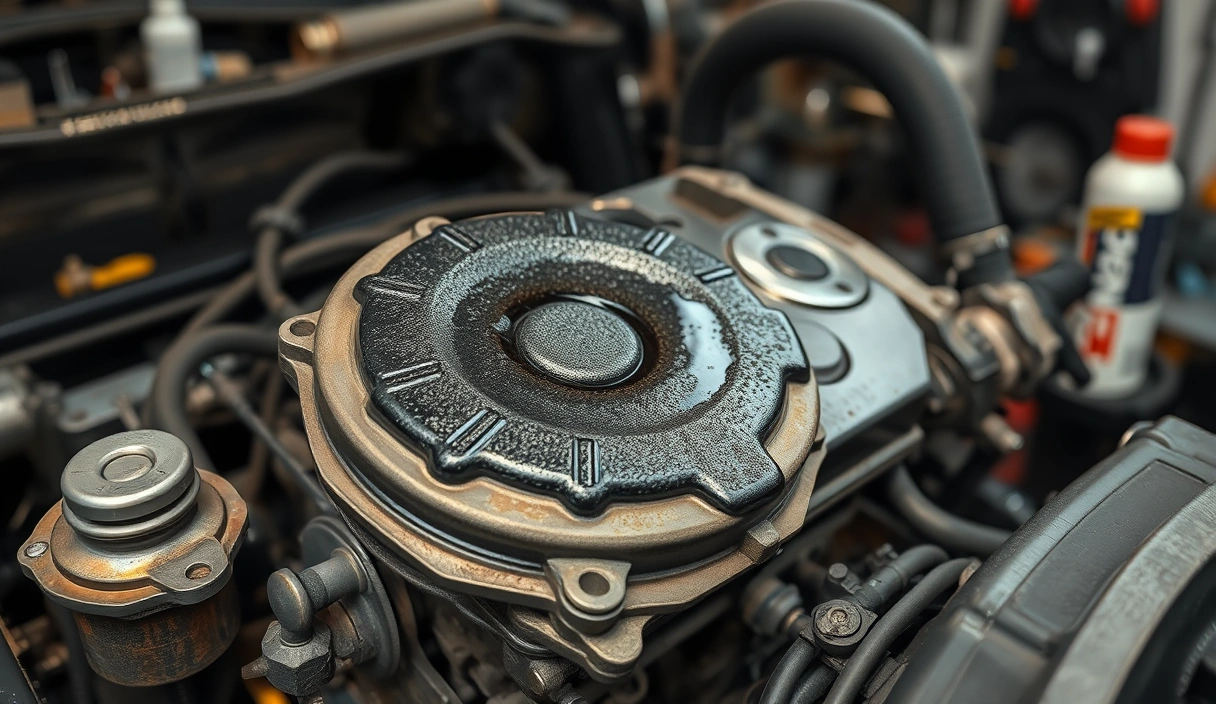
Engine Oil Sludge: Causes, Symptoms, and How to Fix It
Engine oil sludge can kill your engine silently. Learn what causes it, how to spot it, and the exact steps to flush and prevent it for good.