
Oil Change for Diesel Trucks: Intervals, Oil Types, and What's Different
Diesel truck oil changes cost more and follow different rules. Covers intervals, oil types, and certifications for Cummins, Duramax, and Powerstroke.
Contents
An oil change for diesel trucks costs roughly twice what you’d pay for a gasoline vehicle. It also holds more oil, runs a different certification, and has different interval logic than everything you know about gas engine maintenance.
None of this is arbitrary. The Diesel Engine creates a fundamentally different lubrication environment — more combustion soot, higher operating temperatures, more acids in the crankcase — and the oil has to handle it. Here’s what actually differs and what that means for your Cummins, Duramax, or Powerstroke.
Why Diesel Oil Is Different From Gasoline Motor Oil
Diesel combustion produces significantly more soot than gasoline combustion. Soot particles enter the crankcase as blowby past the piston rings and must be held in suspension by the oil’s detergent and dispersant additives rather than being allowed to settle and form deposits. A diesel engine’s oil turns black very quickly — within the first few hundred miles of a fresh change — and this is normal.
The Soot Load in diesel oil places heavier demands on the additive package. As soot particles accumulate, they can begin to flocculate — clumping together — if the dispersant chemistry is inadequate. Soot flocculation increases viscosity beyond spec and clogs oil passages. Heavy Duty Motor Oil formulations carry substantially higher TBN (Total Base Number) than passenger car oil — TBN measures the oil’s remaining ability to neutralize combustion acids. A fresh heavy-duty diesel oil typically has a TBN of 10-12 mg KOH/g; a standard passenger car oil might have TBN of 6-9. That buffer matters across the longer drain intervals common in diesel applications.
There’s also the matter of EGR (Exhaust Gas Recirculation) systems on modern diesel trucks. EGR routes exhaust gases back into the intake to reduce NOx emissions, which increases soot contamination of the oil and raises the oxidation rate. Trucks with active EGR systems need oil formulated to handle this additional chemical stress.
The API CK-4 Certification Standard
Diesel engine oil has its own certification track separate from the API SP/SN system used for gasoline engines. The current standard for on-highway diesel trucks is API CK-4, introduced in 2017.
API CK-4 replaced CI-4 Plus and CJ-4 as the current benchmark. The key improvements in CK-4 over its predecessors:
- Improved oxidation resistance for high-temperature operation
- Better shear stability — viscosity stays in grade across the service interval
- Enhanced aeration resistance for engines with high-pressure EGR systems
- Compatibility with both low-sulfur diesel fuels and biodiesel blends up to B20
API FA-4 is a parallel specification introduced at the same time as CK-4. FA-4 is specifically designed for newer, lower-friction engines running 10W-30 formulations — some newer Cummins applications. If your truck specifies FA-4, use FA-4. If it specifies CK-4, use CK-4. The two are not fully interchangeable.
For older trucks: CK-4 is backward compatible with CI-4 Plus, CJ-4, and CI-4. If your older diesel called for CJ-4, CK-4 meets and exceeds that requirement.
Diesel Truck Oil Change Intervals
Diesel intervals are not fixed at a single number. They depend heavily on oil type, application, and duty cycle.
Light duty / passenger car diesel (Jeep 3.0 EcoDiesel, Ram 1500 EcoDiesel):
- Full synthetic: 10,000 miles or per the OLM
- Severe service (towing, short trips): 5,000–7,500 miles
Half-ton and three-quarter-ton diesel trucks (Duramax 6.6, Cummins 6.7, Powerstroke 6.7):
- Full synthetic: 7,500–10,000 miles under normal operation
- Oil Life Monitor guidance: follow the OLM if equipped — these trucks are tuned for their specific oil volumes and driving patterns
- Severe duty (regular towing, high idle time, dusty conditions, short urban trips): 5,000 miles or more frequently
Heavy duty work trucks with extended drain specs:
- Some newer Cummins applications with specific oils and filtration systems allow 15,000+ mile intervals — this requires OEM approval and often large-capacity oil systems
- Do not attempt extended intervals without confirming OEM support; diesel oil degrades faster than equivalent-interval gasoline oil
The Oil Change Interval for a diesel truck cannot simply be lifted from the gasoline-engine experience. If you’re used to 10,000-mile intervals in a gas truck, recognize that the same 10,000-mile schedule in a diesel under hard use may be pushing the additive package harder than it was designed to run.
Top-Rated Heavy Duty Diesel Engine Oils
* Affiliate links. Prices last updated March 6, 2026.
Viscosity: What Grade Your Diesel Truck Needs
15W-40: The traditional standard for diesel trucks across most climates. Widely available, covers most duty-cycle requirements. Use in climates that regularly reach operating temperature quickly.
5W-40 full synthetic: Better cold-start protection in cold climates. Same operating-temperature viscosity as 15W-40. The preferred choice for trucks operating in below-freezing conditions or extreme cold climates. Mobil 1 Turbo Diesel and similar 5W-40 full synthetic products are the leading options here.
10W-30: Specified for some newer Duramax and Powerstroke applications and all FA-4 applications. Check your owner’s manual if your 2020+ diesel truck specifies 10W-30 — this is increasingly common for fuel economy compliance.
0W-40: Available in some premium diesel formulations. Best for extreme cold starts; overspecified for most applications unless you’re operating in -30°F+.
The rule is the same as for gasoline engines: use what’s on the oil cap and in the owner’s manual. The viscosity grade is engineered for the bearing clearances in your specific engine. Heavier isn’t better — it adds cold-start friction and may not penetrate tight tolerances at startup.
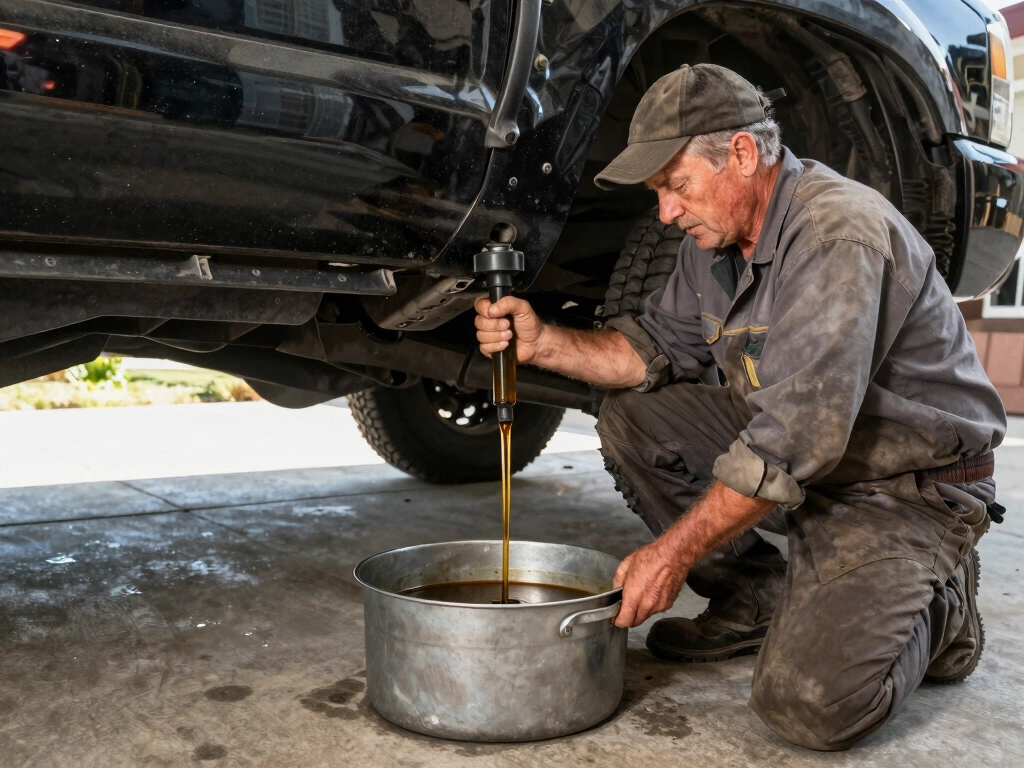
Engine-Specific Notes: Cummins, Duramax, Powerstroke
Cummins 6.7L (Ram 2500/3500, 2007–present): Specify 15W-40 CK-4 for most model years. 2019+ Cummins models with the updated specification allow 5W-40. Mopar-branded fluid or any meeting the Cummins specification CES 20081 or CES 20086 (for newer models). Dodge/Ram trucks with the Cummins are among the most common candidates for extended-drain oil analysis programs due to the large aftermarket support community.
Duramax 6.6L (GM 2500/3500, 2001–present): Specify 15W-40 or 5W-40 for most applications. 2017+ models with dexos-D specification add a proprietary GM approval requirement on top of API CK-4. dexos-D is specifically for diesel engines — different from dexos1 Gen 3, which is for gasoline. If your Duramax says dexos-D on the cap, the oil must carry that specific approval.
Powerstroke 6.7L (Ford F-250/F-350, 2011–present): Ford specifies WSS-M2C171-F1 for the 6.7L Powerstroke, which requires a 10W-30 heavy-duty diesel oil meeting API CK-4 and FA-4. This is the truck where the FA-4 specification actually applies in practice. Using 15W-40 in a newer 6.7L Powerstroke that specifies 10W-30 is using the wrong viscosity — follow Ford’s recommendation.
6.0L and 6.4L Powerstroke (2003–2010): These older engines have notoriously high maintenance requirements including EGR cooler failures. They benefit from more frequent oil changes — 5,000 miles maximum — and quality filtration. High-mileage diesel synthetic blends are commonly used in well-maintained examples.
DIY Cost vs. Shop Cost
A diesel truck oil change is more expensive than the equivalent on a gasoline vehicle because:
- Higher oil capacity: most diesel trucks take 10–13 quarts vs. 4–6 quarts for a gasoline car
- Oil price: quality CK-4 heavy-duty diesel oil typically runs $8–14/quart vs. $5–8/quart for passenger car synthetic
DIY breakdown (10 quarts + filter):
- Full synthetic 5W-40 at $10/qt: ~$100–115 in oil + $20–40 for a quality filter = ~$120–155 total
- Synthetic blend 15W-40 at $6/qt: ~$60–75 in oil + $20–40 filter = ~$80–115 total
Shop rates:
- Independent shop: $80–150 for synthetic blend, $130–220 for full synthetic
- Dealership: $150–250+ depending on location and dealer markup
The DIY saving on a diesel truck is proportionally larger than on a gasoline car — $60–100 savings per change rather than $20–40. With the shorter intervals under severe duty use, those savings add up across a year.
Related Articles
- Best Motor Oil for High Mileage Engines
- How Often Should You Change Your Oil? (The Real Answer)
- Extended Oil Change Interval: How Far Can You Actually Push It?
- Synthetic vs. Conventional Oil: Which Do You Actually Need?
Frequently Asked Questions
How often should you change oil in a diesel truck?
Full synthetic: 7,500–10,000 miles for most half-ton and three-quarter-ton diesel trucks, or per the Oil Life Monitor. Under severe conditions — regular towing, short trips, dusty environments, high idle time — 5,000 miles is safer. Light-duty passenger car diesels (EcoDiesel, etc.) follow the OLM-guided schedule. Always verify against your OEM recommendation.
Can you use regular motor oil in a diesel truck?
No. Passenger car motor oil does not meet API CK-4 requirements. It lacks the TBN levels and soot dispersancy designed for diesel combustion loads. Use oil certified to API CK-4 (or FA-4 if your truck specifies it) in the correct viscosity grade.
Is synthetic oil worth it in a diesel truck?
Yes, particularly under heavy use. Full synthetic heavy-duty diesel oil offers better soot dispersancy, oxidation resistance, and cold-start protection than conventional. For trucks that regularly tow, operate in cold climates, or accumulate idle time, the margin is meaningful. Cost per mile is comparable once extended drain capability is factored in.
What’s the difference between API CK-4 and CI-4 Plus?
CK-4 (2017–present) is the current standard, replacing CI-4 Plus. CK-4 offers improved oxidation resistance, shear stability, and biodiesel compatibility. It’s backward compatible — if your older truck specified CI-4 Plus, using CK-4 meets and exceeds that requirement.
How much oil does a diesel truck take?
Most half-ton to one-ton diesel trucks take 10–13 quarts at an oil change. The Cummins 6.7L takes approximately 12 quarts; the Duramax 6.6L about 10 quarts; the Powerstroke 6.7L about 13 quarts. Always confirm in your owner’s manual and fill to the dipstick MAX mark rather than a fixed volume.
Related Articles
How Often Should You Change Your Oil? (The Real Answer)
How often should you change your motor oil? The answer is in your owner's manual — not on that 3,000-mile windshield sticker.

The 3,000-Mile Oil Change Is Dead. Here's the Truth
The 3,000-mile oil change myth costs drivers money without protecting their engines. Here's what the real interval is — and why the sticker lies.

Extended Oil Change Interval: How Far Can You Actually Push It?
Extended oil change intervals are real for full synthetic on modern engines. Here's what the data shows, when to push it, and when not to.