
Full Synthetic Oil Benefits: What It Actually Does for Your Engine
Full synthetic oil benefits come down to base stock chemistry, not marketing. PAO, antioxidants, and VII polymers explained — plus the cost-per-mile math.
Contents
Every synthetic oil bottle says “superior protection” and “advanced performance.” None of them explain why. The full synthetic oil benefits are real — but they come from specific chemical properties, not marketing copy. Here’s what’s actually happening inside your engine when you run full synthetic.
Full Synthetic Oil Benefits Start With the Base Stock
Full synthetic’s advantages trace back to its base stock. Conventional motor oil is refined from crude petroleum — a process that removes most contaminants but leaves a chemically irregular mix of hydrocarbon molecules. Full Synthetic Oil starts from either Group III base stocks (severely hydrocracked petroleum, stripped down to near-uniform purity) or Group IV polyalphaolefin — PAO — a compound synthesized from ethylene rather than refined from crude.
Group IV (PAO) has a more uniform molecular structure than any petroleum-derived base stock. Molecules that are the same shape and size behave predictably under heat, shear, and oxidation stress. Conventional oil’s molecular irregularity is why it oxidizes faster and thins more dramatically at temperature — not because it’s “worse oil” but because it’s chemically more complex.
For the full comparison of how the base stocks differ chemically, the synthetic vs. conventional oil guide covers Group I through Group IV in detail.
Benefit 1: Cold-Start Protection
Most engine wear doesn’t happen at highway speed. It happens in the 30 seconds after you turn the key — before oil has fully circulated through the bearing galleries and valve train. The crankshaft journals and cam lobes are running on whatever oil film was left from last time until the pump delivers fresh, pressurized oil.
Synthetic’s lower pour point — the temperature at which oil stops flowing — means it reaches critical surfaces faster in that window. A 0W-20 full synthetic flows to bearing surfaces in cold weather measurably faster than a 5W-30 conventional at the same ambient temperature. The “0W” part of the viscosity grade reflects cold-start flow performance directly.
Why Viscosity Index Improvers Matter Here
Viscosity Index Improvers (VII polymers) are long-chain molecules added to multi-grade oil to stabilize viscosity across temperature ranges. They coil at low temperatures (allowing thin flow) and expand at high temperatures (resisting thinning). The problem: VII polymers are the first additive in any oil to mechanically shear down under engine stress. Once sheared, they don’t coil and expand as designed.
Full synthetic base stocks have a naturally higher viscosity index than conventional — meaning less VII is needed to achieve the same multi-grade performance. Less VII in the formulation means less shear degradation over the interval.
Benefit 2: High-Temperature Stability
At 210°F operating temperature under load, conventional oil oxidizes faster than synthetic. Oxidation degrades viscosity, generates organic acids, and creates the thickened deposits that eventually become sludge. The chemistry is a chain reaction: heat causes base oil molecules to lose electrons, generating free radicals that attack neighboring molecules and cause them to cross-link into larger, thicker structures.
Synthetic base stocks resist initiating that chain reaction longer — their molecular uniformity makes them harder to oxidize. But base stock alone isn’t enough.
How Antioxidants Work in Motor Oil
Every motor oil contains an Antioxidant package — typically hindered phenols (primary antioxidants) and aromatic amines (secondary antioxidants). These compounds interrupt the free radical chain reaction before it propagates. Hindered phenols sacrifice themselves by donating electrons to the free radicals, stopping the chain. Aromatic amines regenerate the spent phenols, extending their effective service life.
Once the antioxidant package is depleted — which happens gradually over miles and heat cycles — oxidation accelerates sharply. This depletion curve is one reason the Extended Drain Interval for full synthetic is longer than conventional: the antioxidant package in a well-formulated synthetic has more reserve capacity before the oil “falls off the cliff.”
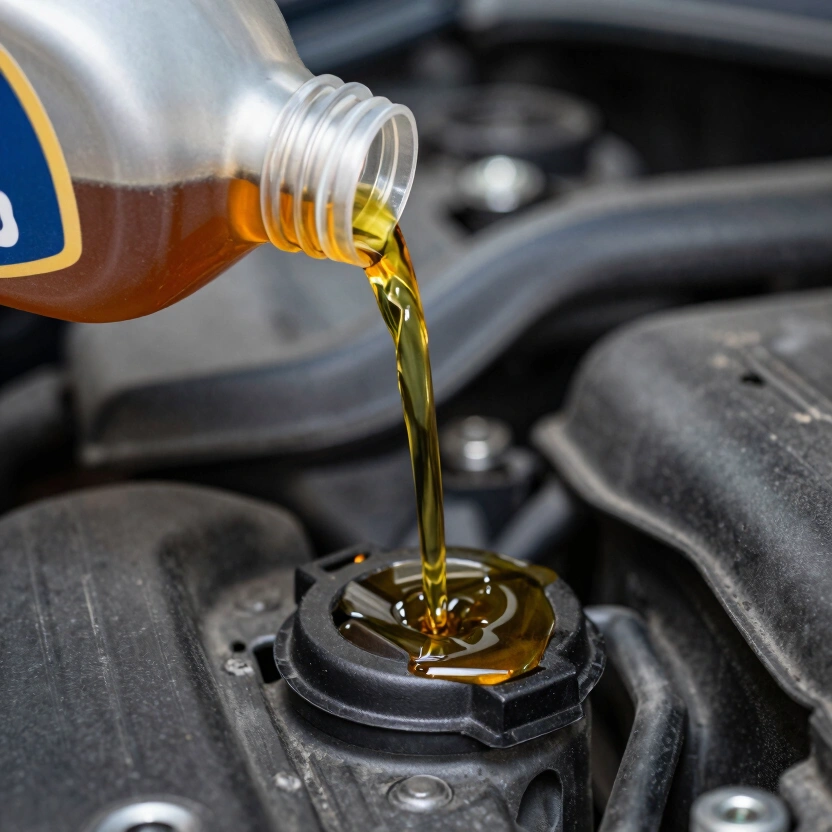
Benefit 3: Turbocharged Engines
In naturally aspirated engines, synthetic’s advantages are meaningful but incremental. In turbocharged engines, full synthetic is not optional — it’s an engineering requirement.
Turbos spin at 100,000–150,000 RPM. Turbocharger bearings are lubricated by engine oil. The heat generated at those speeds, combined with the high exhaust temperatures the turbo is immersed in, creates localized oil temperatures that exceed conventional oil’s design envelope.
The specific failure mode is turbo coking. After shutdown, the turbocharger retains heat but oil circulation stops. Residual oil in the bearing housing sits at extreme temperature without flow. Conventional oil oxidizes rapidly in this scenario, leaving carbon deposits on bearing surfaces — deposits that restrict oil passages and accelerate wear. Full synthetic’s superior oxidation resistance substantially reduces coking in this stationary-heat condition.
Any engine with a turbocharger — essentially every modern performance car, most modern economy cars, and an increasing share of trucks — is an engine where the chemistry difference between synthetic and conventional motor oil is not theoretical. Running conventional in a turbocharged engine at the conventional interval is a reliable path to a $1,500–2,500 turbocharger replacement.
Benefit 4: Extended Drain Intervals
The Extended Drain Interval isn’t a marketing claim — it’s the mechanical consequence of everything above. Synthetic’s resistance to oxidation and VII shear degradation means the oil maintains its protective properties over a longer service window.
Standard full synthetic: 7,500–10,000 miles. Extended-drain formulas (Mobil 1 Extended Performance, Pennzoil Ultra Platinum): rated to 15,000 miles. For how long full synthetic oil actually lasts under different driving conditions, that article runs the specifics.
The cost-per-mile math surprises most people who price oil by the jug:
| Oil Type | Change Cost | Interval | Cost / 1,000 Miles | Annual Cost (12K mi/yr) |
|---|---|---|---|---|
| Conventional | ~$35 | 4,000 mi | ~$8.75 | ~$105 |
| Full Synthetic | ~$38 | 8,500 mi | ~$4.47 | ~$54 |
Full synthetic costs more per jug and roughly half as much per mile. The annual difference is around $50 for the typical driver.
If those numbers convinced you to make the switch, these are the three full synthetics I’d buy for a 5W-30 application — strong review volume, consistent formulation, reasonable price:
Full Synthetic Oils Worth the Switch


* Affiliate links. Prices last updated March 6, 2026.
What the Wear Numbers Actually Show
Beyond the chemistry, engine wear tests back up the interval claims. The API SP certification requires oil to pass ASTM Sequence IVA (cam lobe wear) and Sequence IIIG (high-temperature viscosity stability) testing. Full synthetic oils pass these tests with measurable margin over conventional — that’s why the spec exists, not because of brand marketing.
Group IV (PAO)-based oils typically show the strongest Sequence IVA cam wear results because the uniform molecular structure maintains a more stable lubricating film between metal surfaces under high-load conditions. Group III synthetic performs well in the same tests, which is why most consumer-grade full synthetics meet API SP requirements despite using hydrocracked petroleum base stocks rather than true PAO.
When Full Synthetic Matters Less
The honest answer: for a simple naturally aspirated engine running mild highway commutes with religious oil changes every 4,000 miles, the chemistry improvement is real but the practical margin narrows.
You’d be running clean conventional oil at half its service life, never stressing the oxidation resistance, and never pushing the turbo coking scenario. The cold-start benefit is still there. The antioxidant reserve is still there. But you’re not using it the same way a turbo engine under sustained load does.
The math still favors synthetic by roughly $50/year in most real-world driving patterns. Whether that’s the deciding factor for a Camry four-cylinder with 40 highway miles a day is your call.

Related Articles
- Full Synthetic vs. Synthetic Blend: Is the Upgrade Worth It?
- Synthetic vs. Conventional Oil: The Chemistry That Actually Matters
Frequently Asked Questions
Does full synthetic oil actually make your engine last longer?
Yes, through measurable reductions in wear rate at cold start and high temperature. Turbocharged engines and severe-duty drivers see the largest longevity benefit because those are the conditions that most stress oil chemistry. For mild-climate highway commuters on a naturally aspirated engine, the longevity benefit is real but less dramatic — the cold-start protection still applies every time you start the car, regardless of driving style.
How long can you go between oil changes with full synthetic?
Standard full synthetic: 7,500–10,000 miles in normal driving. Extended-drain formulas are rated to 15,000 miles by the manufacturers. Time matters alongside mileage — change at least annually even if you’ve only driven 3,000 miles, because combustion moisture and acid accumulation happen on a time axis from short-trip driving. The Oil Life Monitor on post-2010 vehicles accounts for both.
Is full synthetic worth it for a normal commuter car?
The cost-per-mile math says yes — roughly $54/year vs. $105/year for conventional at 12,000 miles. The cold-start benefit applies to any engine. The margin narrows for simple naturally aspirated engines on long warm-climate highway commutes changed on schedule. Conventional is technically adequate in that scenario; it just leaves protection on the table for about $50/year.
What’s the difference between Group III and Group IV (PAO)?
Group III is severely hydrocracked petroleum that meets API’s synthetic performance standard — used in most consumer-brand full synthetic oils. Group IV is polyalphaolefin (PAO), synthesized from ethylene with a more uniform molecular structure and higher natural viscosity index. Both dramatically outperform conventional oil. The practical difference is minor for most drivers; PAO’s advantage shows most at temperature extremes and extended drain intervals beyond 12,000 miles.
Can full synthetic damage seals on older engines?
Not on well-maintained engines. Synthetic is a better solvent than conventional — it can dislodge soft sludge deposits that were functionally sealing minor gaps in aging seals. For high-mileage engines (75K+) with unknown maintenance history, transitioning to a high-mileage synthetic blend first is the cautious move. For well-maintained engines at any mileage, full synthetic is safe.
Related Articles

Best Oil for Turbocharged Engines: What Actually Protects a Turbo
The best oil for turbocharged engines is full synthetic API SP — brand and viscosity matter too. Here's what turbos need and which oils deliver it.
Best Synthetic Motor Oils 2026 (Tested and Ranked)
The best synthetic motor oil for most drivers is Mobil 1 Advanced Full Synthetic. Here's how 6 top brands compare — plus which to buy for your engine.

Signs It's Time to Change Your Oil (Don't Trust the Sticker)
The windshield sticker isn't calibrated to your oil or engine. Here's how to actually tell when your motor oil needs changing — and when to change sooner.